
Hey Nerds 👋
I have never been more entertained than I have been with the sheer volume of Jensun memes this week. If the AI bubble was going to correct, this is perhaps the most entertaining outcome (Musk’s Razor strikes). Let’s hope it didn’t take the economy with it.
Life post-midterms will be very different for fintech and digital asset businesses with the committee chairs in Congress changing. But it’s often during these harder moments that innovation really catches fire (that’s your Rant this week 👇 ).
8 days until Fintech Nerdcon. Last call for tickets, and since you’re a nerd, I’m gonna give you a discount code. Use NUTTERTOOLS for 30% off, and I’ll see you there. To the first two people to reply, I’ll also send my personal 100% discount code :). And make sure to check out our 📱 custom event app filled with side quests and fun activities.
PS. How’s your Ocarina of Time November treating you? I’m as far as Zora’s Domain, which, for a Dad, I think is reasonable progress in a few days :)

Build products that move money. moderntreasury.com.
It usually starts with a customer request. Can you support RTP? FedNow? Push-to-card? Stablecoins? Then comes the next one. Because new ways to move money don’t replace what came before. ACH, wires, and even checks are still part of the mix.
Without the right foundation, every new rail means another vendor, integration, and more time before you can ship. Modern Treasury changes that. With one unified API, you can build across today’s payment methods and be ready for whatever comes next.
So as the way your customers move money evolves, your product can evolve with them.
Trusted by Procore, Navan, Morse, and companies of all sizes. Powering $600B+ in payments.
Start building today: moderntreasury.com
You may have seen the news that Apple, Nvidia, Microsoft, and dozens of other major companies have refused to let their stocks trade on OKXICE, the new tokenized equities platform backed by OKX and the parent company of the NYSE. Every one of the Magnificent Seven said no. Bit of a thumb in the eye for “tokenization.”
Meanwhile, the DTCC switched on its Digital Tokenization Service (DTS) in the same fortnight. Fewer people noticed that one.
That’s because press releases are universally confusing.
As someone asked me last week: “Whenever I see these press releases, it sounds like some deep capital markets infrastructure company did a thing, and it’s hard to tell what’s real.”
Let me be unequivocal. What the DTCC launched is the biggest change in financial markets since we stopped using paper stock certificates in the 1970s, and simultaneously, it will be mostly useless for a short while.
How can both be true? The firm at the center of the US stock market can now turn a share into a token, and almost nobody is using that yet. It is also only one of four kinds of stock token. My goal today is to help you understand the differences, and why I think tokens could make a lot more people owners.
Stock tokens are where stablecoins were in 2023 (when I wrote the dollar for non-US citizens). They’re showing early signs of life and are about 18 months away from being the biggest thing happening in capital markets, even if the full rebuild takes decades.
The 1970s showed cheaper settlement increases ownership, and 2023 showed the firms that build while the market is small have an edge when volume arrives.
Why the DTCC launch is the biggest change since the 1970s
What is a security token?
Why do we want them?
The 4 models of stock tokens and why none of them are good enough yet
Why that makes it 2023 again
And how, over time, this makes more people owners.
The biggest shift since the 70s.
When I said this is the biggest change since the 1970s, I was serious. But to understand why, travel with me back in time.
Today, the vast majority of stocks and debt (securities) listed in the United States are stored at the Depository Trust Company (DTC), which was combined with the National Securities Clearing Corporation (NSCC) in 1999 to form the Depository Trust & Clearing Corporation (DTCC).
Both sub-entities were created in the 1970s in response to the 1960s paperwork crisis, when daily trading on the New York Stock Exchange (NYSE) jumped from an average of 5 million shares in 1965 to over 15 million shares by 1968. This forced the entire NYSE to shut down every Wednesday just to keep up with the backlog.
In 1973, the DTC introduced book entry (accounts) instead of paper stock certificates, and in 1976 the NSCC introduced multilateral netting. Meaning, instead of settling every trade individually, the NSCC would combine all trades across the market and figure the single net amount of cash and securities to be delivered.
Netting rules.
Imagine you and two friends go out for dinner and drinks, and you owe each other money throughout the night:
You owe Alex £20 for dinner.
Alex owes Sam £20 for drinks.
Sam owes you £20 for the taxi.
Without netting: Three separate bank transfers of £20 happen (£60 total moves around), even though nobody gains or loses money.
With netting: A central organizer looks at all three IOUs, realizes everyone's debts cancel each other out, and tells you all: "Nobody owes anything." No money needs to move.
In practice, netting is magic. Around 98% of trades and cash cancel each other, meaning only 2% ever needs to be paid or delivered. That turned financial markets into an engine room of the US economy. When only 2% has to move, firms tie up far less cash and collateral, and their cost of capital falls.
For Main Street, that means your lender can package and sell loans, which helped create the lower rates the US enjoyed for a long time (until recently). It lowered the cost of corporate debt, which helped companies expand, and it cut the fees that eat into your 401(k).
Cheaper settlement also made it practical for ordinary families to own shares. It arrived in the same decade as the IRA (1974) and the 401(k) (1978). About a third of US households owned stock in 1989, directly or through a fund. That rose to 58% of families by 2022, the highest share the Fed has ever recorded. Tokens are the next big change to how shares are held and settled.
Most of those families own through a fund or a retirement account. Only one family in five owns a share directly, and the richest 10% of households hold about 93% of all household stock wealth. The economy is rewarding asset owners more than wage earners, so we need to go further.
But first:
What is a security token?
A security token represents a stock or debt security, but instead of being held on paper (like in the 1960s) or as a book entry (since the 1970s), it exists as a token on a blockchain. Unlike ETH or BTC, which exist only onchain, it represents a real ownership stake in a company or a debt issuance. This “real-world” ownership is why some people call them real-world assets or RWAs.
RWA.xyz counts about $431.6 billion of real-world assets onchain today, from Treasury funds like BlackRock’s BUIDL to private credit and repo. It splits them into two types.
Distributed assets can move to a wallet outside the platform that issued them.
Represented assets are a record on a ledger that can’t leave the platform.
Asset Class | Distributed Value | Represented Value | Notes |
|---|---|---|---|
U.S. Treasuries | ~$16.2 Billion | Minimal | Led by funds like Circle's USYC, Ondo's USDY, and BlackRock's BUIDL. |
Commodities | ~$5.3 Billion | Minimal | Almost entirely physical gold tokens (XAUt and PAXG). |
Private Credit | ~$5.1 Billion | ~$22.1 Billion | Most of the $27.2B total is represented (e.g., Figure HELOCs on Provenance). |
Stocks & ETFs | ~$3.2 Billion | ~$0.03 Billion | Nearly all tokenized equities are freely distributed tokens. |
Other Categories | ~$9.9 Billion | ~$369.8 Billion | The vast majority is Broadridge Repo* |
Total | ~$39.7 Billion | ~$391.9 Billion | Combined Total On-Chain Value: ~$431.6 Billion |
*93% of that “other” figure is happening on a private instance of Canton settling intraday repo for Broadridge.
So a security token can be a Treasury fund, a private loan, a stock or an ETF. From here on, I mostly mean the stock kind, which I’ll call stock tokens.
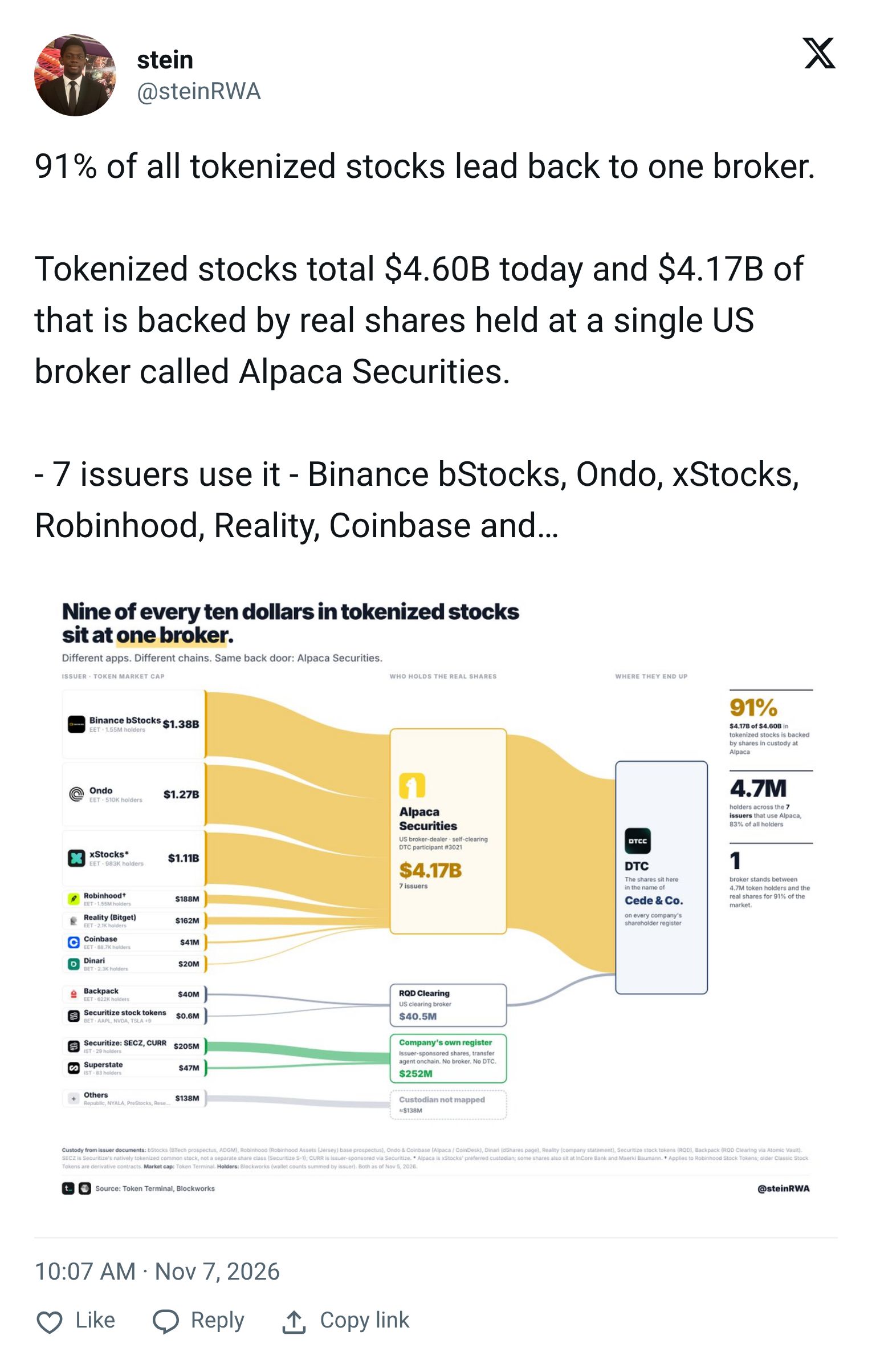
Today’s market is tiny. Tokens make up ~0.004% of stocks and ETFs, ~0.05% of US Treasuries, and ~1.86% of HELOCs. The stock token market is nearly 100% wrapped tokens (a token backed by a real share held at a broker), and the vast majority of that runs through a handful of brokerages.
Alpaca is the API-first broker holding the real shares behind most of these tokens. In many ways, Alpaca is to stock tokens what Lead Bank is to stablecoins.
So why have I spent over 1,000 words on a market this small?
Why do we want stock tokens?
There are two reasons. The first is that it’s better, faster, and cheaper. The second is that, because of that, it widens the aperture for who can be an asset owner. In this K-shaped economy, that is a very good thing.
Assume an asset is natively issued as a stock token, and out of the box you get a ton of benefits (some of which you lose with other designs).
24/7 Settlement. Like stablecoins, tokens work on weekends and around the clock. This can lower the cost, especially when crossing borders.
Wider distribution. A stock token (in theory) just needs compatible software to work. Early stock tokens are often adopted in Global South markets (just like stablecoins).
Atomic settlement. You can swap cash for stock tokens instantly. Today, the cash and the stock sit on separate systems at separate firms. (Instant settlement has a catch for netting. More on that below.)
Programmability. Bake in features like voting in an AGM, or dividend payments to the token itself, rather than through a complex network of intermediaries and paperwork. Even engage with your shareholders directly in other ways (e.g. marketing/loyalty).
Composability. A stock token can plug into other products, for example as collateral for a loan from any lender, including one that isn’t your broker. Today that’s much harder with shares in a brokerage account, where your lender is usually the broker that holds them.
Put those together, and it gets cheaper to issue shares to more people, and cheaper for those people to hold them. If the shares you own were tokens, you could vote at the AGM from an app and earn loyalty discounts from the companies you own. You could borrow against them cheaply, or use them to cut the cost of a mortgage, instead of selling them when you need cash. That’s the kind of thing that matters to Main St.
These are all possible.
We’re just a ways off yet. How the token is built decides which of them you get.
There are roughly 4 models of stock tokens.
Each gives the holder and stock issuer different experiences.
Wrapped: e.g. xStocks. If you hold TSLAx, a custodian holds a real Tesla share and Kraken’s issuer, Backed, gives you a token. You cannot vote and retain none of the shareholder rights.
Pooled stocks: e.g. OKXICE. A venue tokenizes real shares and approved traders buy and sell them against a liquidity pool. Each token must carry the same vote and dividend as the share.
Mirrored stock as a token: e.g. DTCC. The original stock is immobilized, and the DTCC issues a token in its place.
Natively issued as a token: e.g. Superstate / Figure. The original stock is a token issued on a blockchain.
Each of these has different trade-offs for the stock issuer and stock holder across shareholder rights, new features (the benefits above), and backward compatibility with the existing stock market. I call this the stock token trilemma.

Here is how each model scores.
Wrapped stocks maximize innovation and work with “any stock” because the token is synthetic. The cost is that the holder gets no shareholder rights and the issuer gets no say.
Mirrored stocks maximize backward compatibility and preserve shareholder rights. They trade off a lot of innovation.
Native stocks maximize innovation and rights. They give up backward compatibility.
What about Pooled Stocks? Ahh, the curious case of OKXICE, where the NYSE’s owner and OKX created a pool of stocks that could be traded as tokens, highly innovative, backward compatible, and preserving shareholder rights. Except the SEC’s innovation exemption lets any listed company opt out, and most of them did.
Of the 62 companies OKXICE first lined up, 56 (about 90%) have opted out. The only six that haven’t are crypto companies: Coinbase, Robinhood, Circle, Strategy, Securitize, and BitGo.
4 not very good options
Each one falls short in a different way.
Wrapped stocks may have some appeal offshore, but they’re facing a Congress that’s much more dubious of digital assets, especially when they’re not regulated by the US.
Pooled stocks, the OKXICE model, only work if the issuer agrees. So far only crypto companies have.
Mirrored stocks are live at the DTCC, which has 34 securities (stocks, ETFs and Treasuries) on Canton and Besu. Of the two chains, Canton is the public one, and it appears to have made one single transaction since launch. With 20 firms signed up, including JPMorgan, Citi and Morgan Stanley, that can change.
Natively issued stocks are fascinating but still an experiment. For many of their benefits to scale, they need a rule change from the SEC so they don’t require a transfer agent and a physical mailing address.
The DTCC model has two other limitations this early in its life.
Both Besu and Canton are set up to deal with the asset (the stock) and not the cash (you paying dollars for your stock). So they use the existing infrastructure (e.g., wires) to settle those trades, which means cut-off times, collateral, and a potential mismatch between when a trade happens and when cash moves.
Platforms like Hyperledger Besu (an open-source Ethereum client, often used by banks for closed-loop chains) are already hitting scaling limits. As one senior FMI leader told me at Sibos a few weeks ago, 'we’re already hitting volume limits on Besu, and we’re a long way from scale,’ which is a pattern I suspect many will experience.
In other words, it’s not yet finished.
And let’s say we solved scalability and had 24/7 settlement of the asset and cash leg; we’d still have a challenge.
Faster settlement can be worse for capital efficiency. Remember the dinner bill? Netting works because everyone settles up at the end of the night. If every trade settles the moment it happens, there’s nothing left to net, and firms need more cash on hand to cover each trade. The DTCC’s own roadmap already lists digital cash, collateral tools and onchain netting, which target this problem and the cash problem above.
(In my day job, we’re doing some pretty fun research into how you can have the best of both worlds, faster settlement and collateral efficiency. Tokens are actually incredibly interesting for that.)
All of this is facing a less favorable Congress.
Democrats won both the House and the Senate on 3 November.
That puts Elizabeth Warren in line to chair the Senate Banking Committee from January, and she has form on exactly this topic. In 2025, she warned that under the Clarity Act, Meta or Tesla could put its stock on a blockchain and “poof!” escape SEC regulation. Clarity then failed in the Senate in September. If it doesn’t pass before the new Congress sits on 3 January, it starts again in the committee she’s expected to run.
We do still have the SEC’s innovation exemption.
It runs until 2031 and lets venues like OKXICE trade stock tokens, as long as each token carries the same rights as the real share. It doesn’t need Congress. But it’s temporary (SEC chair Paul Atkins calls it a bridge to proper rules), and a Warren-led committee would oversee the SEC and vet anyone nominated to run it.
All of this becomes one more reason to slow down if you run a bank, and to put the budget somewhere else.
Congress is about to get tougher, America’s biggest companies said no to OKXICE, and the DTCC’s public chain has barely moved. Every AI project on the CFO’s desk promises a faster payback. Cutting tokenization back to a working group is the easy call for the 2027 budget.
I think that would be a mistake, because the new brokerages and buy-side firms won’t wait. Remember BlackRock launched BUIDL and its Bitcoin ETF in 2024, under Biden, with Gary Gensler still running the SEC. When the politics changed, BlackRock already had the products and the customers. Banks that sit out two years of politics could spend the next decade buying this from Robinhood and BlackRock.
It’s 2023 again
If you run a fintech like Ramp, Chime or Nubank, the banks’ hesitation is your opening.
In 2023, stablecoin supply had shrunk to about $124 billion. Silvergate and Signature had collapsed, and the SEC was suing Coinbase and Binance. PayPal launched PYUSD in the middle of it, and Stripe paid $1.1 billion for Bridge the following year. When the GENIUS Act passed in 2025, those firms were ready. Stablecoin supply is now about $291 billion.
In March 2023, Circle survived having $3.3bn of reserves stuck at Silicon Valley Bank; 18 months later, Stripe acquired Bridge, and 9 months after that, GENIUS passed.
Stock tokens are at the same point. The market is tiny, Congress is cooling, and the incumbents are hedging. The possible Achilles ' heel for stock tokens will be convincing Fortune 500 companies that it's worth listing their stock as a token. But with this scale of market structure change, it’s a matter of when, not if the shift comes.
If you’re deep into stablecoins today, ask yourself what you’d build if it were 2023 all over again.
If your customers already hold dollars in your app, could they hold US shares the same way, around the clock, from São Paulo or Mexico City?
Could they borrow against those shares in your app, instead of selling them?
Which of the 4 models would you build on, knowing issuers can opt out of some of them?
Pick one of those questions and put a team on it before the banks set their 2027 budgets.
We can make people owners
Like stablecoins, the early adopters of stock tokens may be offshore.
But unlike stablecoins, stock tokens will be a barbell. The biggest users will be in the global south and on Wall St at the same time.
As they begin to experiment, the market will get a taste of lower costs and capital efficiency, and want more.
The market hasn’t decided on its approach yet. It’s likely the DTCC’s mirrored stocks live alongside natively issued stock tokens for years to come. And as these become normal, Wall St will start to see the enormous efficiencies from releasing collateral that’s stuck over a weekend at a venue to cover trades and settlement.
At home, I think the long-term prize is bigger.
In the years since the 1970s, the USA became the world’s financial market, and many of the middle class became owners. But the social contract that drove that and the technology enabling it have now outlived their usefulness.
Tokenization presents a way to lower the cost of participation, and make complex financial products something everyone can have. That’s why you should pay attention.
We can make more people owners.
If you’re building here, hit reply and tell me what you’d do if it were 2023 all over again.
ST
