

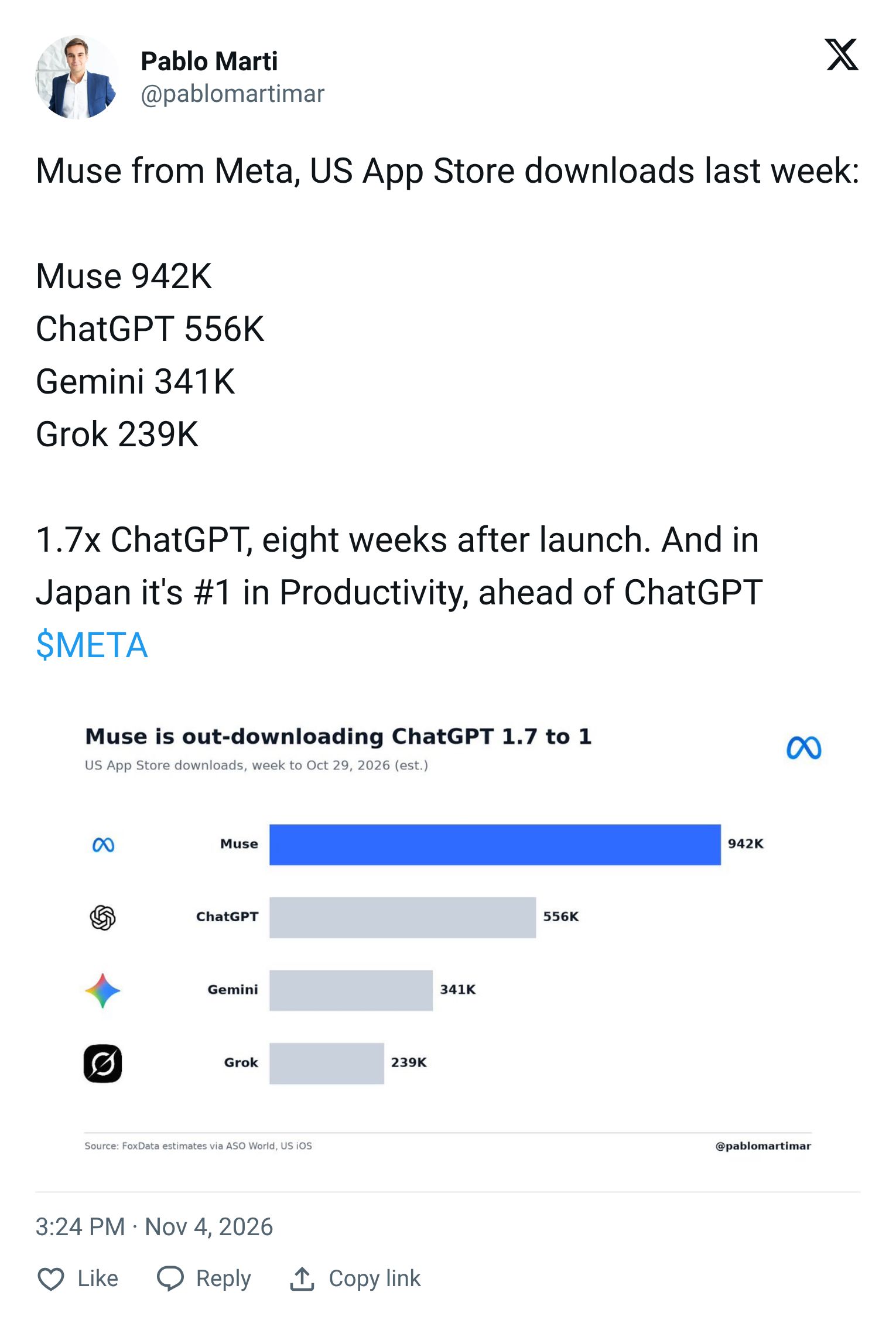
Amazon recently blocked Meta’s Muse AI agent from shopping on its site, highlighting the growing problem of trust in agentic commerce.
As personal shopping agents like Instinct and Muse gain traction, merchants need a reliable way to make sure the agent is acting on their human’s behalf.
Sardine’s Know Your Human (KYH) connects AI agents to the real people behind them. It shares the human’s device identifier and IP address through HTTP headers, helping merchants approve more transactions with confidence.
The same approach can extend to sharing KYC details with banks and fintechs to enable agentic banking.
Here's this week's Brainfood in summary
👀 Things to Know:
💸 4 Companies:
Content Corner: An AI Agent is a thin file borrower
Things to know 👀
Revolut has closed the share sale it opened in July, at a $115bn valuation. Employees and early backers sold existing shares to funds led by Glade Brook, Coatue, Durable Capital, T. Rowe Price and Baillie Gifford, so no new money went into the company. The price is 53% above last November's $75bn.
🧠 US readers. You are not paying enough attention to Revolut. Every European bank CEO is. I give it 5 or so years, and every US bank CEO will too. Oh, and their US CEO is speaking at Fintech Nerdcon this year. Which is 10 days away!
🧠 Revolut is now worth more than BNY or Barclays. Its $115bn private valuation is ahead of Bank of New York Mellon (BNY), at about $99bn on the stock market. Barclays is worth about $74bn and Lloyds about $71bn. It is worth more than every UK bank except HSBC, and is closing in on Capital One, at about $123bn.
🧠 Yes, arguably private markets have a premium, but consider that they had a revenue of $6.0 billion, a profit before tax of $2.3 billion, and a 35% return on equity. Compare that with their peers:
Revolut 35% RoE
Nubank 33% RoE
JPMorgan 20% RoE
NatWest 19% RoE
Wells Fargo 15% RoE
Bank of America 14% RoE
HSBC 13% RoE
Barclays 11% RoE
Citi 8% RoE
That's QUITE a lead, and it's one Revolut is improving over time with AI.
🧠 The 53% jump mostly tracks revenue, which grew 46% to $6.0bn in 2025. Investors paid about 19 times the previous year's revenue in both of the last two sales. Pre-tax profit grew faster, up 57% to $2.3bn.
🧠 Revolut is going global with licenses. This year it launched banks in the UK, Mexico, Australia and New Zealand and won banking licences in France, Colombia and Argentina. It plans to open its US national bank in the first half of 2027, subject to final approval.
🧠 Revolut has now sold staff shares three years running, at $45bn, $75bn and $115bn. Stripe does the same, with tender offers at $91.5bn in February 2025 and $159bn this February. Both companies give staff cash and set a fresh price each year without listing.
🧠 Two of the five leads, T. Rowe Price and Baillie Gifford, are best known for running funds of listed stocks. Nik is doing the podcast circuit, and one wonders if launching in the US is set to be timed with a listing. Reports put the IPO no earlier than 2028. When Revolut lists, some of its biggest IPO buyers may already own shares.
Chime says revenue growth has climbed all year, from 25% in Q1 to 32% in Q3 ($718m). It made $44m of net income (a 6% net margin, up 16 points) and raised its full-year guidance for revenue and adjusted EBITDA. A year ago, it lost $54.7m, and adjusted EBITDA is now $137m, a 19% margin (up 14 points). Active members grew 20% to 10.9m, with a record 1.8m added over the last year, including about 500,000 in Q3. Direct depositor growth sped up for the third straight quarter (although Chime still doesn't say how many it has). Revenue per active member rose 10% to $270, and purchase volume grew 19% to 40bn including outbound instant transfers). A Chime member is now worth nearly 10x what it costs to win one, up from about 8x at IPO.
🧠 Plenty of bankers said Chime would never be profitable and would never win the direct deposit. Q3 makes both claims hard to defend. I’ll keep saying this: the existence of a business that is profitable and serves a lower-income population with intention and care is a thing we should continue to celebrate. Meanwhile the large banks would happily “de-risk” this segment for being unprofitable.
🧠 The US has a handful of mid-sized challengers. Chime, SoFi, OnePay, and Current sit in that 5 to 10+ million member range, each innovating in their own ways.
🧠 I’m so interested to see if and how the arrival of Nu impacts these companies, or if it’s just one more pointed at the incumbents. If you’re a large bank now, you’re surrounded by competition for younger or lower-income consumers.
🧠 Nu launched in the US in September through Lead Bank, with a 3.5% savings rate, a 1.5% cash back card and free remittances. Nu US CEO Cristina Junqueira says the goal is to be people's primary banking relationship.
However…
🧠 Chime is also moving up the income spectrum. People on $75k+ are its fastest-growing group, and Prime members (who deposit $3k+ a month) bring in more than twice the average member's revenue. UBS says Prime now targets earners up to $200k.
🧠 Chime also goes to employers to get the paycheck at source. I like this as a distribution strategy. I can’t recall the last Neobank that intentionally did this. We’ve seen “earned wage access” and direct-to-employer as the only channels. But rarely as just another. Chime expects employer deals to drive member growth from 2027.
🧠 It will be some time before we see the impact of the Stride Bank acquisition. I’m interested to see whether Chime can maintain this growth rate as it mobilizes as a full bank. My experience has always been the path to getting a charter, while not trivial, is far easier than keeping it.
🧠 Chime is almost boring in its consistent execution, and I mean that as a compliment. Many years ago, people wrote them off as a group that could never be profitable or a real threat to banks. Now they're a major franchise.
🧠 They’re also quietly shipping AI features that don’t suck. Jade AI has become a financial coach. I’d love to see metrics on how this is performing and if users are benefiting. In theory, a good AI agent should improve financial health and your product's NPS.
Visa launched the Visa Agentic Commerce Benchmark on 5 November. It ran 22 AI models from 12 labs through 15 shopping tasks, three times each. They were testing what happens before the buy button is pressed. So this was an evaluation of how well the models could work out what a shopper wants and pick the right product. They set up a scenario where one AI plays a shopper who hides most of what it wants, and the agent has to find out before it buys or walks away. Each run ends at a simulated till, with no checkout or payment. 57.2% of runs passed (best model 82.2%, worst 28.9%), and a model passed all three runs of a task only 34.2% of the time.
Visa stopped the test at the buy decision and says payment testing comes next. So this tests the agent up to the buy button, not what happens after you press it.
🧠 That high failure rate is creating a user adoption problem. That's striking when six in ten UK adults told YouGov they'd stop using an AI shopping agent after one mistake.
🧠 The strongest models passed more. Meta's Muse Wonder passed 82.2% of its attempts, Claude Fable 5.1 passed 75.6%. But here’s the wild thing. More than half the failed runs still ended in a purchase, which is 23.1% of all runs.
🧠 The pass rate hides what happens when an agent gets it wrong. Muse Wonder (82.2%) mostly didn't buy when it failed (6 of 8 times), while Claude Fable 5.1 (75.6%) bought every time it failed (11 of 11). Failing to buy is probably a better outcome than buying the wrong thing. If the agent bought the wrong thing, that turns into a chargeback which is painful for everyone especially the merchant.
🧠 This benchmark is exceptionally useful, especially to the labs. Visa has shared the benchmark with the leading model providers, and I'd expect them to train their models to climb it (aka hill climbing).
🧠 Agents fail at buying things for two reasons, and Visa tested the first. The agent can't do the job because it misses what you care about, and a stronger model is more likely to fix that.
🧠 The second is the payment stack blocking the agent. If it's not you typing your 16 digits, how would the merchant or your bank know it's you and not a stolen card? Fixing that needs them to know which agent is buying and who pays if it gets it wrong.
🧠 We're very early. Agents pay today with your real card, a one-time virtual card, a network token or a balance you load up front (more in Payments are the new ads). The first two break most often, which leaves network tokens and stablecoin balances.
🧠 I think we get both. Banks are holding back on agent tokens until they agree who's liable, and that takes time.
The midterms were the biggest political event US prediction markets have ever had… if you look at it by open interest. [See Predicted, a Brainfood production, latest piece for more].
The night before the vote, Prediction Markets held $1.0bn in open political contracts, about 30% more than the $778m peak during the 2024 elections. Most of that ($838m) sat on Kalshi, up from $279m before the 2024 vote.

Two newer venues had their first big election too. Rothera held $82m in open interest, and Polymarket US held $80m, in the first federal election where Americans could legally use Polymarket.
🧠 You wouldn't know it from the volume numbers. Bloomberg reported that political wagers was about 1% of October 2026 volume on Kalshi and Polymarket, down from roughly two-thirds in 2024. And on volume, they're right. Politics was 1.3% of volume traded on Kalshi from the start of October 2026 to election night. But it was 32.7% of the money held there in open interest.
🧠 People buy political contracts and hold them. Volume counts every time a contract changes hands. Open interest counts the money sitting in contracts that haven't settled yet. A sports bet is usually placed and settled in an evening, but a Senate contract can be bought in the spring and held until polling day.
In October 2026, every dollar held in Kalshi's crypto markets traded $427, sports $35… while politics traded $1 per dollar. Kalshi's 2028 presidential markets already hold $270m in a.
🧠 The money came onshore. In 2024, the offshore Polymarket International held more than twice as much on the presidential race as Kalshi ($248m compared to $111m). This time, its House and Senate markets held $25m, and Kalshi's held $103m. So most of the political money now sits on US-regulated venues that Robinhood and Coinbase customers can reach from their apps.
🧠 The favorites won. Democrats took the House and the Senate, and favorites won 479 of 487 races on Kalshi and 419 of 426 on Polymarket. Predicted checked 1,339 Kalshi midterm markets against their price the night before, and contracts priced between 70¢ and 90¢ came in 88% of the time.

The OCC gave its bank examiners a framework on 4 November for judging how banks use AI, which the agency now calls "Super Intelligence" (SI) after an October executive order. (It’s still AI to me, and Twitter is still Twitter). It covers 16 areas, from privacy to vendor contracts, and includes a sample four-tier risk scale. Interestingly, it sets no new rules for banks, and the OCC plans to update it regularly as the technology changes.
🧠 The OCC tells examiners to treat AI as part of the risks banks already manage. For me, that’s good news, because nobody has to build a whole new compliance function around AI. AI is a tool, and banks should use it thoughtfully.
🧠 The old model risk guidance (SR 11-7) created a universe of work and exam pain for anyone underwriting credit or using AI. That pain made banks tread carefully. Regulators replaced it in April and left generative and agentic AI out of scope, and this framework is written mainly for those tools. Model risk gets one section out of 16, and the rest covers areas like humans in the loop, data, privacy, and vendor contracts.
🧠 The OCC focuses on accountability, meaning which human owns each AI use case and how that's recorded. The bank stays accountable even when a vendor builds or hosts the model. It calls for records sufficient to rebuild a material decision and warns against choosing a worse system just because it's easier to document.
🧠 A human in the loop only counts if that person has the skill, authority, and time to say no. The OCC asks how many agents one person can credibly watch. And like, that’s a tricky one to answer. Because how you do the oversight may change over time. It’s a similar bottleneck to coding. Coding happens fast, but code review or testing is where the human slows things down. That too is getting automated.
🧠 TL;DR: Don't be lazy and outsource your thinking to AI. For example, in BSA and customer service, it flags incomplete data and hallucinated answers about fees, rates, or account status. Things can slip through the cracks, and if your examiner spots them, expect to hear about it.
🧠 The OCC treats prompts as a privacy risk. Prompts, outputs, and logs can become stores of customer data, and a model can memorize what it learned and repeat it later. Every major vendor now has a version of their models for enterprise that they “don’t train on” - but the banks are still being extra cautious there and understandably so.
🧠 The OCC ranks AI by what happens if it goes wrong. An autonomous payment agent sits in Tier 1 (critical); no matter how well it performs in testing, it could still yolo move all a customer’s money to the wrong place. AI-assisted underwriting and AML alert disposition sit in Tier 2. Because it’s bad, but only the bank would feel that.
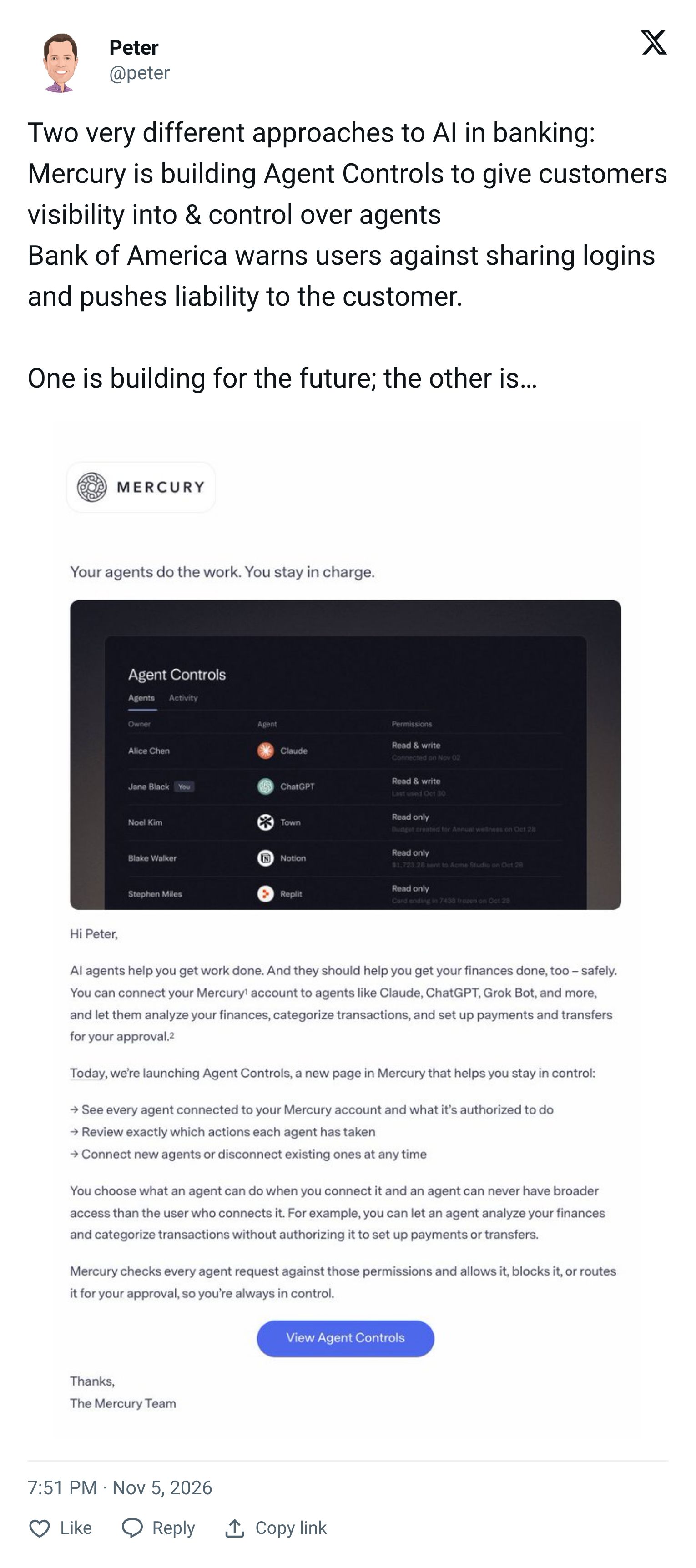
🧠 What about customer agents? Muse, Instinct, and the banks blocking them? The OCC points to identity checks, proof a customer authorized the agent, velocity limits, and the ability to revoke access. So it’s not an outright ban. It’s a sensible checklist.
🧠 This looks like a menu of things to get right to take to banks to partner with them for personal agents (and others).Expect those questions, plus a request for notice before you ship new AI features.
🧠 I haven't spoken to many banks about this yet, but it's quite brief yet, to my layperson eyes, quite helpful. AI is already in production at many banks, and everyone documents those risks their own way. This will come up in exams, so knowing how the OCC thinks about it is helpful.
4 Companies 💸
1. Symphony Get Travel Rewards for Saving
Symphony lets people earn travel points on money they set aside, choosing to receive their returns in cash, points or a mixture of both. Points can be used for flights, hotels, and experiences. Symphony makes money from investments including government debt, private credit, and crypto lending; this carries investment risk and isn’t an FDIC-insured savings account.
🧠 Sorta Bilt for Travel. Travel and experiences are THE motivator for the under-35s. Turn that into something they need. Savings. Smart. Credit cards have trained people to get very excited about collecting points for a holiday, and I like applying that motivation to saving. I’ll be keen to see how they get distribution for this idea, because on the surface, this existing makes me happy.
2. Supertake Turn your investment thesis into a portfolio
Supertake lets people describe an investment idea, such as “humanoid robots are coming to every home,” and have AI assemble a portfolio of US-listed stocks around it. Users can connect Robinhood to submit trades, approve them individually or authorize Autopilot within limits they set. The private beta also lets people test ideas with simulated money and share portfolios for others to copy.
🧠 This is a smart way to turn natural language into stock portfolios, but why wouldn’t Robinhood just build this? Public already turns prompts into investable indexes, but Supertake puts this experience on top of any existing brokerage account. I can imagine a newsletter or community forming around a shared thesis, with readers adapting the portfolio to their own views. That way it doesn’t matter what your broker is, it matters what you believe.
3. Grade — Track creator work and pay what’s owed
Grade helps brands and agencies track creators’ posts, calculate what they’ve earned, and pay them in batches. Teams can combine flat fees with performance bonuses, while Grade collects identity and tax information and gives finance one consolidated invoice.
🧠 The rise of new media for marketing is enormous. Budgets have dramatically shifted from traditional media to new. But agreeing to pay a creator for views sounds simple until someone has to count them, apply the bonus rules, and get finance to pay. Grade’s useful starting point is that tracking the work is free. Give the marketing team visibility, and you’ve solved a problem immediately. Then monetize the payment portion.
4. Gordon AI — Fraud checks for payments made by agents
Gordon offers companies running AI agents checks on proposed purchases before money moves, looking for problems such as malicious instructions hidden in product listings or a purchase that no longer matches the owner’s request. It can approve, block or send a payment for review, and keep a signed record that merchants and payment providers can retrieve when investigating a dispute.
🧠 An agent can use the right credentials, stay under its spending limit, and still buy something its owner never wanted. My Instinct agent actually reacted to an email I asked it to look at with “oh there was some malicious agent facing code in there” a few days ago. This will become common. This isn’t the type of thing traditional fraud tools look for, but they could. Which makes me wonder what Gordon’s durable advantage will be over time.
Good Reads 📚
AI agents will need to earn financial trust, just as people with no credit history do. If an agent borrows or chooses financing on your behalf, your credit score tells the lender whether you can repay. It doesn’t tell them whether the agent will make sensible decisions, follow your instructions, or resist manipulation. Shivani the founder of Tala, proposes a gradual approach to creating trust just as Tala has done with borrowers in emerging markets.
Verify the agent’s identity and what it’s authorized to do.
Start it with narrow permissions and a small credit limit.
Track its decisions and behavior.
Expand its access as it demonstrates reliability.
🧠 We first have to get agent identity and permissions right. Step 1 isn’t fully agreed or used at scale. There’s a web of protocols and ideas for how that should work, but its work in progress.
🧠 The idea that permissions should evolve with evidence is useful and not widely discussed. We should collect more data and evidence over time. Agents earn trust, it isn’t something you can give simply by verifying its identity alone.
🧠 Above all, we need a definition of an agent. Who made the agent? What underlying model was it running? Did a human authorize its scope (give it an intent).
Tweets of the week 🕊
That's all, folks. 👋
Remember, if you're enjoying this content, please do tell all your fintech friends to check it out and hit the subscribe button :)
Want more? I also run the Tokenized podcast and newsletter.
(1) All content and views expressed here are the authors' personal opinions and do not reflect the views of any of their employers or employees.
(2) All companies or assets mentioned by the author in which the author has a personal and/or financial interest are denoted with a *. None of the above constitutes investment advice, and you should seek independent advice before making any investment decisions.
(3) Any companies mentioned are top of mind and used for illustrative purposes only.
(4) A team of researchers has not rigorously fact-checked this. Please don't take it as gospel—strong opinions weakly held
(5) Citations may be missing, and I’ve done my best to cite, but I will always aim to update and correct the live version where possible. If I cited you and got the referencing wrong, please reach out
