

Amazon recently blocked Meta’s Muse AI agent from shopping on its site, highlighting the growing problem of trust in agentic commerce.
As personal shopping agents like Instinct and Muse gain traction, merchants need a reliable way to make sure the agent is acting on their human’s behalf.
Sardine’s Know Your Human (KYH) connects AI agents to the real people behind them. It shares the human’s device identifier and IP address through HTTP headers, helping merchants approve more transactions with confidence.
The same approach can extend to sharing KYC details with banks and fintechs to enable agentic banking.
Here's this week's Brainfood in summary
👀 Things to Know:
💸 4 Companies:
Things to know 👀
OpenAI started rolling out ChatGPT Wallet on November 13 to U.S. Pro subscribers with eligible U.S.-issued cards. Your dot finds the item, you review the purchase and approve it with Face ID or another biometric check, and the payment network issues a token linked to the card you picked. The merchant charges that card without seeing its actual number. OpenAI says users keep their card rewards and protections for eligible disputes.

🧠 With ChatGPT Wallet the merchant can charge the card you picked. In Payments are the new ads, I wrote about Scott Wessman picking Amex in Muse and getting stuck when Best Buy asked for the security code on the virtual card that Stripe Link used to pay (because it slots a temporary card between yours and the merchant). With ChatGPT Wallet, the token is linked to your own card. That keeps the merchant purchase, your rewards, and eligible disputes on the account you chose.
🧠 Chase gives you a good sense of where banks are on agents. JPMorgan blocks outside agents from acting on customer accounts, and yet, eligible Chase cards work in ChatGPT Wallet after you approve the link in the Chase app. You still approve each purchase separately. This reminds me of how you have to approve Apple Pay with your bank.
🧠 Your Face ID approval is tied to the merchant, the items, and the total. The network checks the token against it before your bank sees the charge. I still want to know how issuers use that record in a dispute. We haven’t seen the rulebook for that yet. If the bank can see exactly what you approved, “my agent bought the wrong thing” gets much harder to claim.
🧠 Biometrics on every purchase could get old pretty quickly, but it does add security. An agent with a budget can buy while you sleep. OpenAI says it expects to add preapproved purchases within limits over time. Network tokens and balances can both win here.
🧠 ChatGPT is positioned as an aggregator but is trying to be merchant-friendly. The platform that helps the consumer decide what to buy also takes you to checkout, and right now, it’s not charging merchants anything extra. Unlike Meta, for whom it’s the explicit strategy. OpenAI’s pitch to merchants is that they keep the customer relationship, pricing, and returns.
🧠 Just when you thought Muse and Instinct were leading on commerce, OpenAI turns up inside an app it says has 1.2 billion weekly users. The wallet starts with U.S. Pro subscribers. I’m super curious to see how 1) Adoption goes and 2) what conversion looks like vs. other payment types.
🧠 Fun to see companies like VGS and Sardine* mentioned in the overall news. Companies that may not be household names, but the types of infrastructure players who can make all of this work.
🧠 If you sell online, find out this week if you block agents by accident, then decide on purpose. OpenAI’s Commerce Partner Playbook gives you a place to start. A working payment token still needs a checkout the agent can reach.
United said on 11 November it will ban unauthorized AI agents like Meta's Muse from booking its flights, on its app, its website, and through travel agencies. A day earlier The Verge found that Muse can no longer browse eBay listings. They join Amazon, JPMorgan, Schwab, Kohl's and Neiman Marcus.
🧠 For merchants, volume is so low that the cost of blocking is almost zero, even in canonical use cases like food delivery. Uber reported that agents booked 4 Uber rides and about 500 Uber Eats orders in a week of 320M trips. Blocking costs a merchant almost nothing today.
🧠 An agent logging in with your password looks the same to a fraud team as a bot with a stolen card. United says sharing your login with an agent exposes your data and your MileagePlus miles.
🧠 An agent that chooses where you buy turns the merchant into a commodity. United CEO Scott Kirby said "I don't want to create another middleman."
🧠 There’s also the backdrop of every CISO in full freak out mode. AI models are getting better at breaking into software (see Anthropic's Project Glasswing). Security teams want fewer unknown bots near customer accounts.
🧠 The smart merchants are building a happy path for the agents they choose. Walmart launched an Agent Gateway in beta, Shopify lets Muse check out through UCP (the protocol it built with Google), and eBay is building its own gateway. United says it has no agent partners yet.
🧠 PAP, the Personal Agent Protocol from Meta and Sierra, gives an agent a login so the merchant knows which agent arrived. The merchant also needs proof that a real person sent it and meant to buy that exact thing. Sardine* launched Know Your Human last week to link an agent to its human.
🧠 Right now a merchant looks to be on the hook for refunds and chargebacks, with no extra sales to show for it. Visa and Mastercard have yet to publish a rule for who pays when an agent buys the wrong thing.
🧠 I expect more blocks until the card schemes publish a liability framework. The first agents allowed in will be ones each merchant picked.
Goldman Sachs, Citi, Santander, Deutsche Bank and other financial firms have committed about $270M to Project Faro, a new company that will issue a dollar stablecoin, Bloomberg reports. The money covers five years of running costs, and launch is planned for the first half of 2027. The project started with 10 banks in October 2025 and grew to 21 institutions in September.
🧠 Thirteen months in, Faro is still hiring a CEO and still choosing a name. It hasn't said which blockchain it will use. And I’m not sure they have agreed on what use case will go first. It’s very obviously a defensive play, but to what end?
🧠 I get the idea. A bank is unlikely to distribute a rival's coin (cough, circle, cough), so a shared issuer gives all 21 a dollar token they can each accept.
🧠 But look at the nature of business they’re each in. Goldman is a capital markets house, Lloyds and Santander fund themselves with retail deposits, and Fidelity already issues its own dollar stablecoin.
🧠 Several members also have other bets running. Citi partnered with Coinbase on stablecoin payments and runs its own tokenized deposit service, and UBS is an Open USD partner.
🧠 This is an expensive hedge. $270M over five years is $54M a year. Split evenly across 21 firms, that's about $2.6M each, which a global bank can pay and wait. But again, to what end?
🧠 Open USD is here and being promoted by both card networks. Partners mint for free, share the reserve income, and can earn equity for the supply they bring, while Faro asks its members for the money first. The bear case for OUSD, is it runs all card network settlement someday. The bear case for Faro is it never gets off the ground.
🧠I spoke to a very senior banker this week who said “Simon, I’m finally with you on the need for a utility stablecoin.” That’s because a bank doesn’t want to accept another banks tokenized deposit (because the liquidity coverage ratio on that would be 100% destroying lending capacity). So for cross border, you need a utility stablecoin.
(If you want a deeper read on how banks can use stablecoins this way, I co-authored this whitepaper for Tempo Off Hours Cash Settlement for Banks - Yep, I do things for the day job).
Alta raised a $47.5M Series A led by Index Ventures this week, after a $32.5M seed co-led by Airwallex and Capital 49, the Airwallex founders' fund. Alta is building a blockchain for banks and payment companies, and its release names Airwallex CEO Jack Zhang as a co-founder alongside CEO Loong Wang and President Catherine Porter. Payments on Alta stay private between the two parties, and each institution's sanctions and policy checks run as part of the payment. Airwallex is building on Alta and will connect it to local payout networks in 200 countries and 90 currencies. The first product helps businesses hold less cash in prefunded accounts by funding each market just in time and keeping the rest in yield-bearing tokenized assets.
🧠 Zhang became the famous anti-stablecoin voice on X. This is quite a reversal, but by starting with the Airwallex network of off-ramps, it could offer a “best of both” between fiat and crypto rails.
🧠 What’s the use case? Airwallex pays out fast because it holds pools of local currency around the world. Alta's release estimates $4T sits in prefunded accounts like those globally. The goal is to release that and rebalance using stablecoins.
🧠 Airwallex is the reason to take Alta seriously. Stablecoins move dollars fast, but most recipients need local currency in a bank account. Airwallex has spent nearly a decade building the regulated accounts, FX, and local payment connections that do that last step.
🧠 Airwallex is also the only named user. Alta calls itself neutral infrastructure for banks and payment providers. I couldn't find another named institution or a launch date. At worst, this is a better treasury management solution for Airwallex and clients, but the real test is: will adversaries use it? (e.g., non-Airwallex clients or even competitors)
🧠 Would Wise, Nium or a bank settle on a chain a rival's CEO co-founded? Alta's privacy design would hide their payments from Airwallex. And interestingly, both Nium and Wise have been quite wary of stablecoins so far.
🧠 Crowding in competitors is hard and rare. Bank of America ran BankAmericard until 1970, then handed control to the banks that issued the card. Those banks formed the company that became Visa. There are so many lessons in one from many that are applicable today.
Rain announced Agent Vaults on 10 November. A customer funds a vault by ACH, SEPA, FPS, card or stablecoin and sets the rules, and their agent gets a single-use Visa or Mastercard for each purchase with the amount, merchant and expiry fixed. Rain sells it to the platform that builds the agent, which runs vaults under its own brand and earns interchange on the card spend.
🧠 Embeddable wallets for agents are more interesting than they sound. Rain's example is a bakery whose agent pays flour suppliers by itself and waits for the owner to approve a USD 2,400 mixer. It works like a corporate card for an agent, with a cap the agent can't raise.
🧠 Agentic commerce has a conversion problem, and it starts at the retailer's website. A retailer's bot protection can block the agent before it reaches the checkout. Blend ran a test agent against 200 UK and US retailers in September and 29 refused it, including 16 of the 80 large ones.
🧠 The payment can fail too. An issuer that sees an unknown agent can't tell a good customer from a bot using stolen card details, so it can block the transaction.
🧠 A vault fixes the payment half. The money is already loaded and the card is locked to one merchant and one amount, so Rain, as the card issuer, should approve it.
🧠 The website half goes away when the retailer is the one giving the card to the bot. A marketplace that builds its own agent and embeds a vault will let its own agent in, and Rain says it is already working with marketplaces on vaults. That makes vaults a good fit for a narrow set of use cases today.
🧠 Balances / Vaults are a huge opportunity. Because of this conversion issue. Stablecoins are a much less complex, easier-to-manage product than a prepaid card.
🧠 Rain is taking a clear shot at wallets like Link and Shop, which are gaining traction as embedded wallets for agents. With Link or Shop, the wallet keeps the customer and the fees. With a vault, the platform that built the agent keeps both.
🧠 I'm curious to see if Rain can get traction. Agent payments are some way from home base for a company built on stablecoin-linked cards. It's also the kind of ambition that gets rewarded if the execution is right.
4 Companies 💸
1. Hyphenate — AI workers for finance teams
Hyphenate helps finance teams invoice customers, chase payments, process supplier bills, keep the books up to date, and track cash across bank accounts. It says it learns how your company works from historical spreadsheets, emails, and system records, then uses that knowledge to carry out the work in your existing software. The agents match payments to invoices, prepare accounting entries and reports, and bring people in for approvals and judgment calls.
🧠 I like that this “reverse engineers” the spreadsheets where a company’s actual finance processes live. That avoids “prompting it to kinda do the right thing.” There so many lookalikes to this, it’s hard to know which to pay attention to. Hyphenate says it has multi-million-dollar annual recurring revenue. So that’s traction.
2. Nous — An FCA-regulated AI agent for UK households
Nous handles household bills, subscriptions, appointments, repairs, purchases, and refunds, including dealing with suppliers on your behalf. You give it your address and can connect your email, bank accounts through Yapily, and WhatsApp, then ask for things like “find a local plumber” or “when does my mobile contract run out?” Premium adds logins for everyone in the household, unlimited services managed, subscription tracking, and cash rewards for eligible switches.
🧠 This feels like Instinct or Muse built for the UK, where comparing energy deals means understanding usage, standing charges, and exit fees before calling something “cheaper.” I like that Nous explains the trade-offs and distinguishes permission for one switch from permission to keep switching within agreed limits. Nous is an appointed representative of FCA-authorized Stubben Edge & Partners, which gives its covered regulated activities a firm responsible for oversight and compliance. This could be a really really interesting approach, making them a long-term acquisition target, or able to do things other agents can’t.
3. Lette — AI assistants for rental property managers (UK)
Lette helps property managers answer rental inquiries, arrange viewings, complete leases, and look after residents once they move in. Residents can ask questions or report a repair through email, WhatsApp, SMS, voice, or its app. Lette answers routine queries, coordinates maintenance, and flags missed rent for staff to follow up.
🧠 An empty property costs its owner rent, and slow replies can lose a prospective tenant before they’ve even booked a viewing. Automating the chasing and scheduling could help managers fill homes sooner while giving staff more time for residents who need help. Lette says it supports more than 30,000 homes and helped one operator add over 1,000 homes without increasing headcount. There’s plenty of these in the US, but the UK seems to be speedrunning every AI category now too.
4. AgentBank — Spending controls for AI agents
AgentBank offers separate spending balances for AI agents, virtual cards, and limits on how much each agent can spend. Developers and finance teams can set approval rules for larger purchases or unfamiliar merchants and export records showing what was bought, why, and who approved it. The site describes a spend management service using banking and card partners, although I couldn’t verify that live accounts and cards are available.
🧠 Looks like Natural, but if ClaudeSlop designed the homepage. Great URL though. Giving agents their own budgets and purchase records makes sense when the alternative is handing them a shared company card. AgentBank’s own public metadata labels its current mode “referral,” so I’d want to see an agent complete a real payment before putting it alongside Natural.
BONUS: Machenta is building a foundation model for instant robot learning, teaching robots a new task from a single demonstration. It just raised a $40m seed round, and yes, it’s in the UK too. The UK is cookin right now, and you’re probably sleeping on it.
Good Reads 📚
When you say “AI” you could mean the way it was trained, the data center it runs in, the products built on it, or the broader trade. When someone says “AI is a bubble,” they could be right about the trade but wrong about the products. The debates between skeptics and proponents are so often arguing past each other that it’s difficult to have a genuine debate at all.
🧠 “Regulating AI” could mean the decision system for your loan, the possibility of future superintelligence, or deep fakes and synthetic media copyright.
🧠 The topic is now so big we need more precise language. That may take a while.
Tweets of the week 🕊
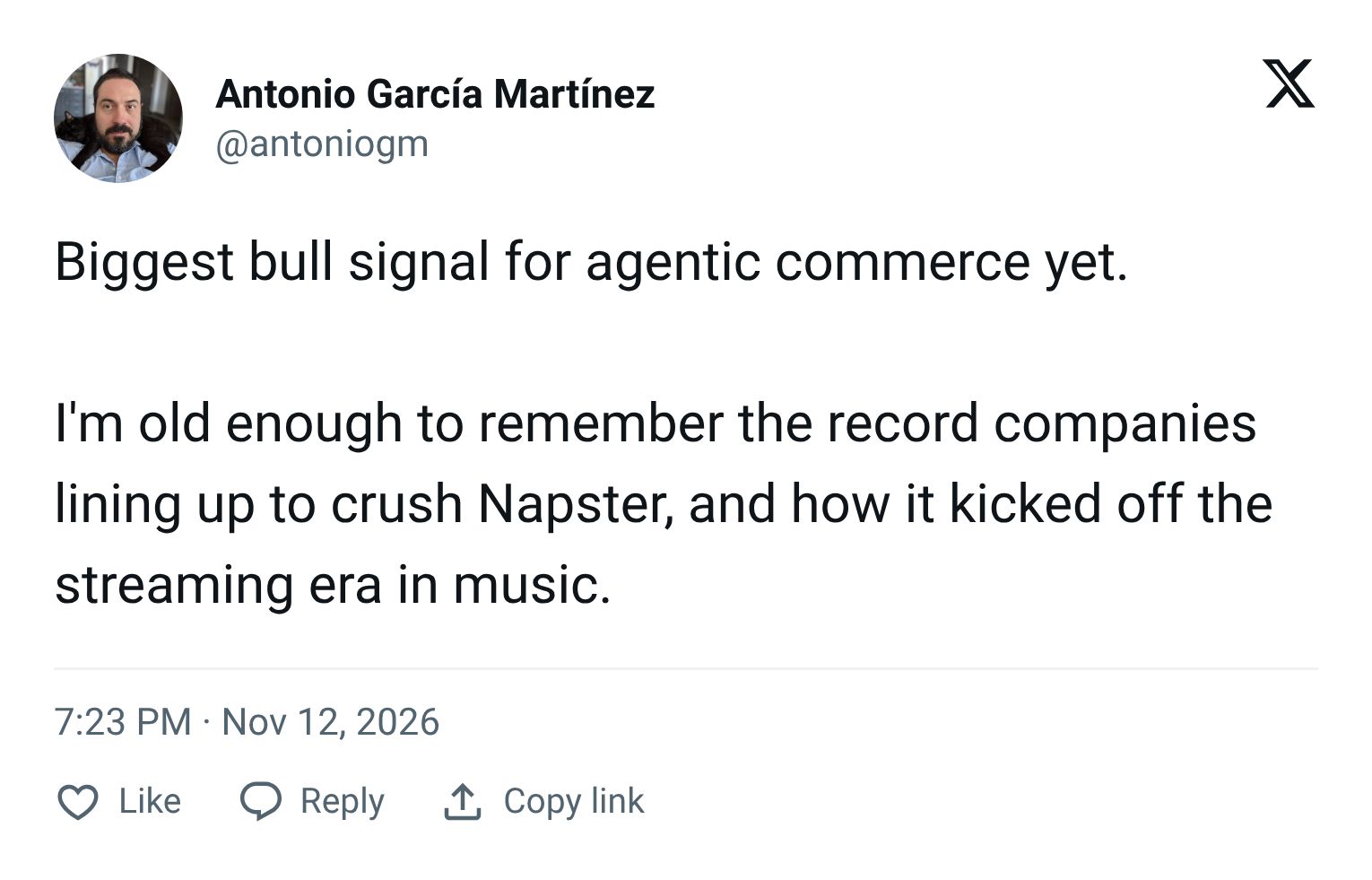
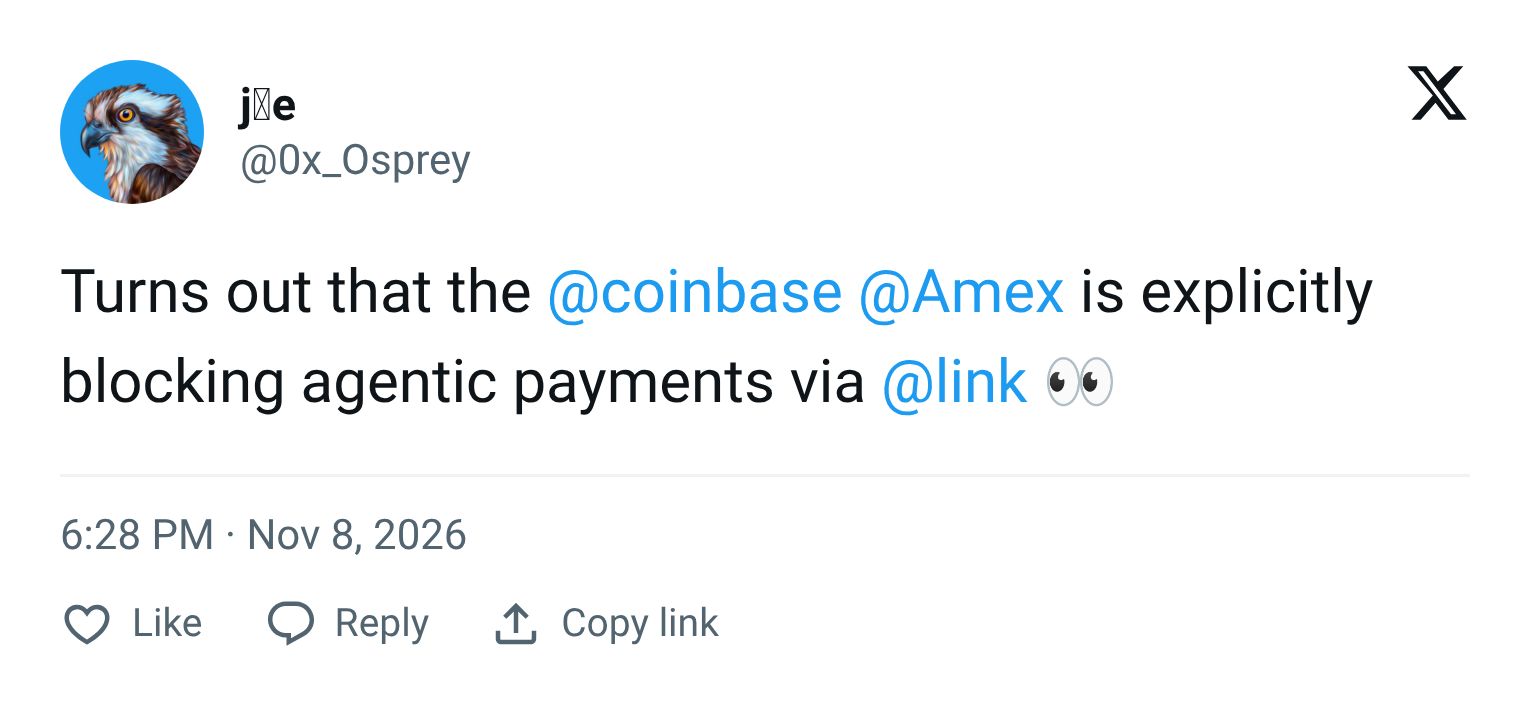
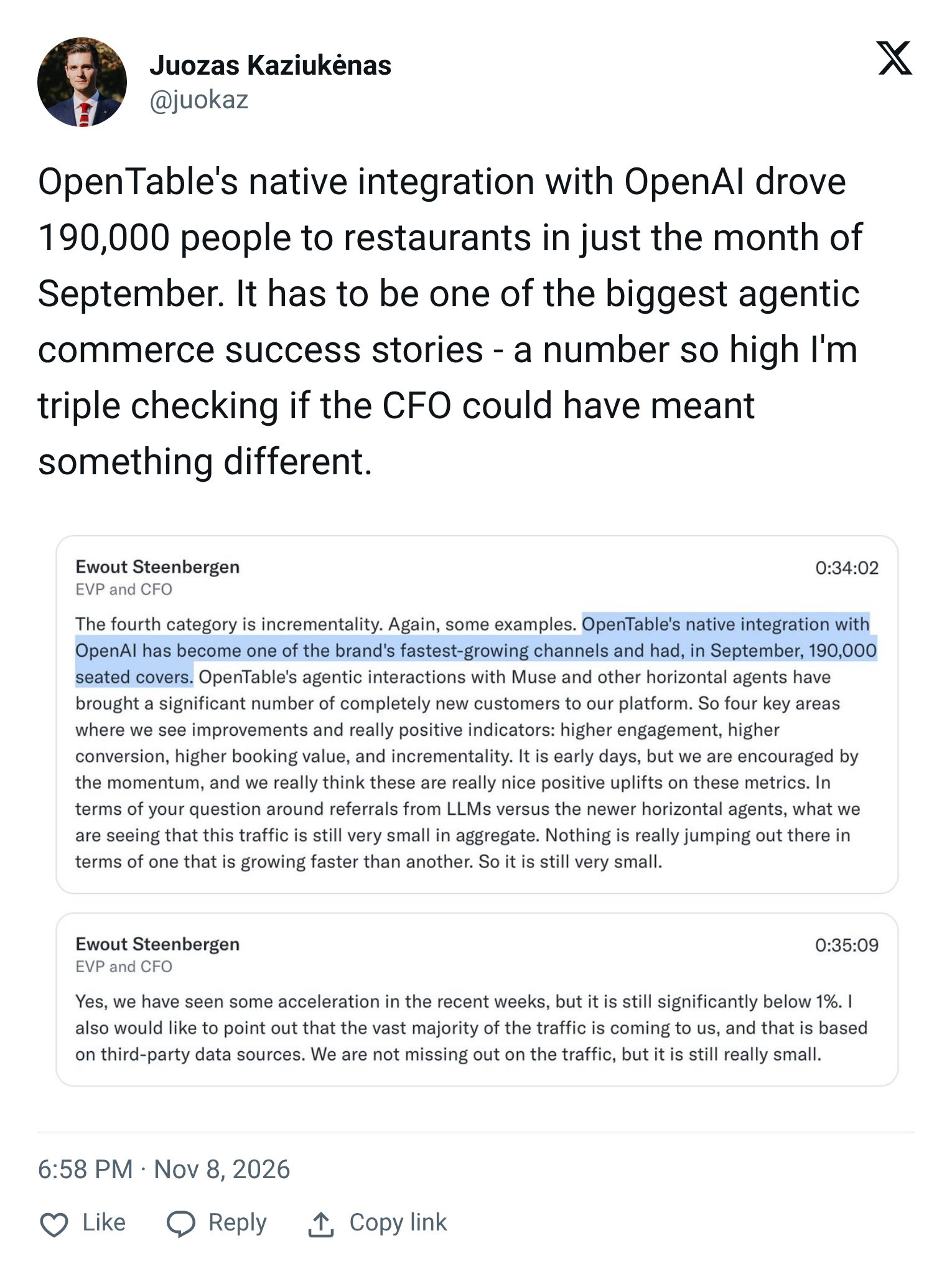
That's all, folks. 👋
Remember, if you're enjoying this content, please do tell all your fintech friends to check it out and hit the subscribe button :)
Want more? I also run the Tokenized podcast and newsletter.
(1) All content and views expressed here are the authors' personal opinions and do not reflect the views of any of their employers or employees.
(2) All companies or assets mentioned by the author in which the author has a personal and/or financial interest are denoted with a *. None of the above constitutes investment advice, and you should seek independent advice before making any investment decisions.
(3) Any companies mentioned are top of mind and used for illustrative purposes only.
(4) A team of researchers has not rigorously fact-checked this. Please don't take it as gospel—strong opinions weakly held
(5) Citations may be missing, and I’ve done my best to cite, but I will always aim to update and correct the live version where possible. If I cited you and got the referencing wrong, please reach out
