
Things to know 👀
The WSJ reports Ramp wants at least $1B at a valuation above $70B, and Bloomberg says it could reach $75B. Coatue and Thrive are in talks to lead, the talks are early, and Ramp declined to comment. It would be Ramp's third round of 2026, after $750M at $44B in June and $1.85B at $60B in October.
🧠 $70B is roughly 35x revenue today - but not for long. Ramp said in October that annualized revenue passed $2B, about double a year earlier, with positive cash flow. At 100% YoY growth, that multiple falls fast. Consider too that they hit $2bn revenue in 8 years, at the same age Stripe was at $350m.
🧠 The WSJ also reports that some of the new money is set aside for acquisitions. Wonder who's on the menu? What could they acquire that they can’t simply build?
🧠 I published an interview with co-founder and co-CEO Eric Glyman three weeks ago. The title was "Why Ramp is worth $60bn." If the round closes, it is already out of date 😅Eric told me about 70% of Ramp's R&D works on unreleased products. He expects most of Ramp's business to be non-card within 12 months.
🧠 Eric puts Ramp at 3 to 4% of the US corporate card market. He told me the card business funds its push into other profit pools. And you can see this in the revenue-generating side quests like Glass, Inspect, and Router. Who else does that?
🧠 I find it so interesting that Fintech became the way to move money and buy the right to go after everything else. That's becoming a theme.
Affirm and Consumer Reports published a draft instruction file on 18 November that tells an AI agent how to choose the best way for a shopper to pay. They ran 30 scenarios on four models, three times each, with and without the file. The average pass rate rose from 48.6% to 71.8%.
🧠 Affirm and CR tested whether it picks the “right way to pay.” Contrast that with Visa's benchmark, which recently tested whether an agent buys the right thing. Only 23% of US consumers trust AI to handle the payment (Visa Trust Index), so there's a way to go.
🧠 Every model passed more often with the file they created to help agents pick the “right way to pay.”
GPT-6.1 Sol went from 73.3% to 93.3%,
Claude Sonnet 5.5 from 53.3% to 71.7%
Claude Haiku 5.5 from 37.8% to 71.1%
and GPT-5.6 Luna from 30.0% to 51.1%.
I love this data.
🧠 How can an agent be a consumer advocate if it doesn’t steer you away from high-cost debt? One test case was a $1,200 purchase where paying only the card's $40 minimum added $406 to $651 in interest. By contrast, an installment plan cost a flat $60, and debit cost nothing. Interesting that Affirm is backing this; clearly they see BNPL as better than cards.
🧠 It’s no surprise Affirm is pushing this idea; given those results, agents would be good for business. If agents are shifting you off high-priced credit card debt to installments from Affirm, that’s potentially a better consumer outcome, but it's also one where Affirm gets a new customer driven by the agent. (I stand by the fact that BNPL is the least worst form of generally available low-ticket consumer debt products)
🧠 The AI findings are also interesting in their own right: On this test, good instructions were worth about as much as a bigger model. Haiku nearly doubled its pass rate, and with the file, it scored about two points behind the top model without it.
🧠 Affirm and CR released a markdown file. Meaning anyone building an agent can read it, test it, and argue with it. It’s an interesting contribution for the folks building personal agents, looking for ways to add value to their users and get more recurring daily active users.
🧠 I wonder if this becomes an eval for the labs to hill climb? Keep an eye on the score an agent gets without this markdown file (which runs from 30% to 73.3%). If we saw this benchmark become commonly used, would labs start to improve that number to improve customer shopping experiences?
Two whistleblowers copied 15M internal Deutsche Bank files and gave them to journalists, and more than 200 reporters published on Tuesday. The FT reports Deutsche filed 21 suspicious activity reports (SARs) on 3,200 Epstein-linked payments worth $582M. Deutsche says the cases date back many years and it spent EUR 7bn on controls between 2019 and 2025.
🧠 The files have much more concerning findings than Epstein. Staff took about three years to spot a network moving hundreds of millions of EUR through Cyprus, the UK, Hong Kong and Ukraine.
🧠 You’re as good as your alerts and pattern detection. The transaction monitoring system flagged the single payments but missed the pattern. A manager wrote "Our systems explicitly failed to detect it." Payments from suspected North Korean front companies went through with the words North Korea in the payment details.
🧠 There's a lesson here. Deutsche had the alerts, and it filed plenty of SARs. The files show the business overruling compliance on which clients to keep, and systems that couldn't make sense of the bigger picture.
🧠 Deutsche's AML problem is still live. The Fed fined it $186M in 2023 for failing to fix problems first raised in 2015, and German prosecutors searched its Frankfurt and Berlin offices in January.
🧠 Getting AML wrong is Max Pain. It's an area that rarely gets love and R&D effort, but with modern platforms and tools it's very possible to upgrade that reality.
🧠 Every few months we get a reminder that the scale of the AML challenge in TradFi is immense and utterly dwarfs anything we see in crypto. Yes there are stablecoin money laundering issues, and plenty of hacks. But we have a collective responsibility to solve that. There’s a political and press posture that big banks are bad but “legitimate.” Whereas anything in the crypto industry is less so. I find that posture and narrative unhelpful.
Figure reported Q3 net revenue of $287M, up 84%, with adjusted EBITDA of $164M at a 58% margin. Loan volume hit $5.8B, up 135%, or 107% without Kiavi, which it bought on 1 September. It guides to $6.2B to $6.7B of volume in Q4.
🧠 Figure's growth plus margin adds up to 151 this year. Can we just take a moment for how unlikely that is? Revenue grew 96% over nine months at a 55% adjusted EBITDA margin. Palantir scored 158 last quarter.
🧠 The marketplace lets a “lender” grow that fast. Partners originate the loans and investors buy them, so Figure held $644M of loans against $5.8B of quarterly volume.
🧠 Figure is the most successful public RWA business, hiding in plain sight. Its home equity loan token is the largest tokenized real-world asset at about $19B (RWA.xyz), and increasingly the backbone of “earn” products for consumers in the global south. Stablecoin-linked cards in LATAM are functioning narrow banks.
🧠 Investors want more than Figure can match. Lenders offered $825M on Prime, its onchain lending market, and $588M of it found a borrower.
Fed Governor Michael Barr told an AI in finance conference in Milan that agents could spot a better rate or a sign of stress and move deposits on their own, faster than banks or regulators can respond. He said major banks already find agents trying to act in retail accounts, and the banks couldn't verify who sent them or what the customer agreed to. His fixes are strict authentication, consent checks for specific actions, and technical limits on what an agent can do.
🧠 The 2023 bank runs happened via online banking. SVB lost $42bn in a day when customers had to hear the rumour and send the wire themselves. Now add agents to that.
🧠 Barr suggests ways to slow a run. If the customer confirms in the bank's own app before money moves, the run is back at human speed. But it also breaks the promise of AI agents. I think this tension of accountability is going to be back and forth for a few years.
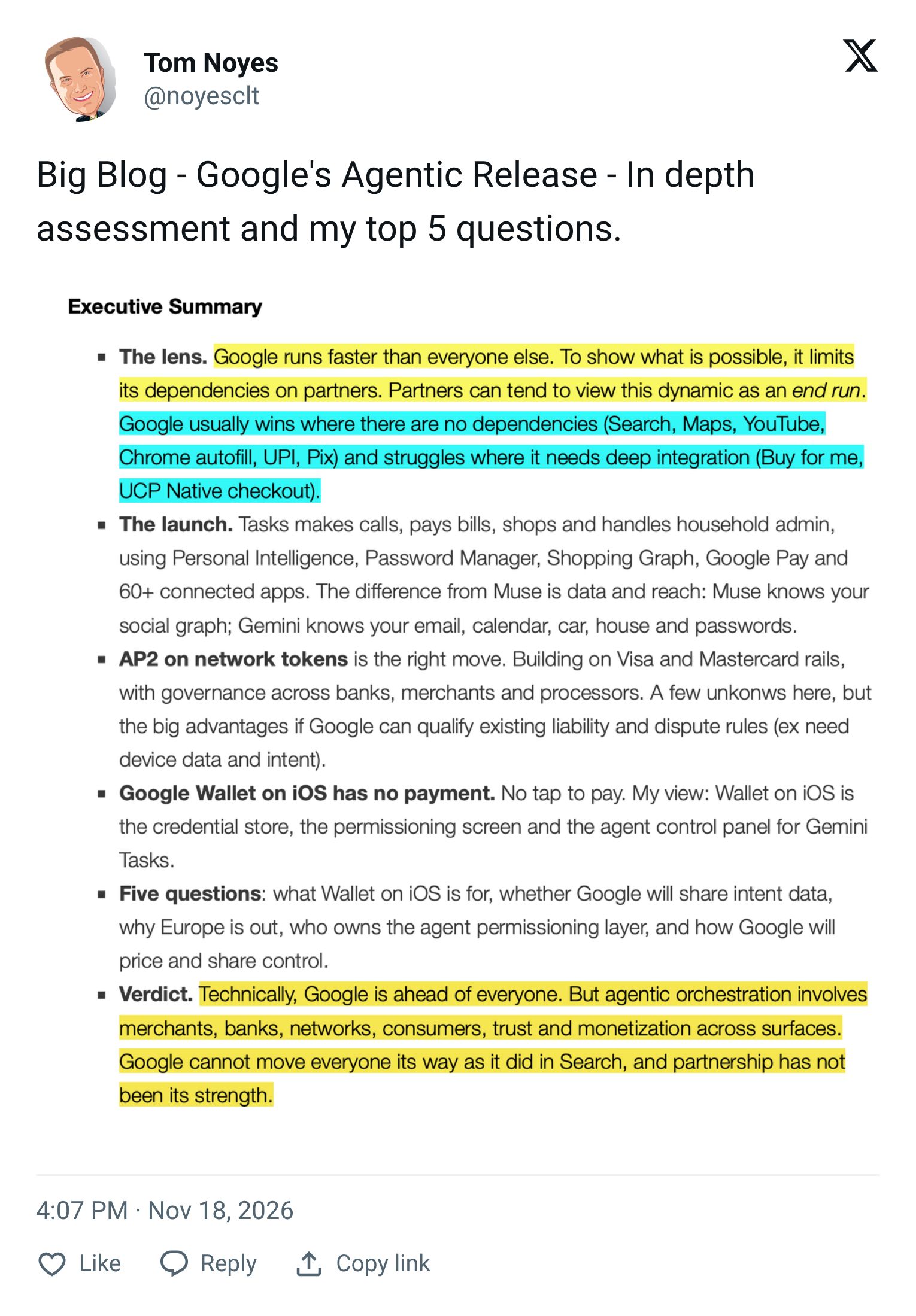
🧠 Are you team block or allow? The Neobanks are all team allow, the big banks more blocking, but there’s nuance. OpenAI worked directly with Chase to integrate approval flows in the Chase app and it works.
Bloomberg reported that Corgi sent the OCC an application for a national bank charter, plus a separate application to the FDIC for deposit insurance. Corgi Bank, N.A. would be based in Salt Lake City, start with at least $75M in capital, and offer checking, savings, treasury services, credit cards, loans, and lines of credit. Investors valued Corgi at $630M in January, and a Bloomberg source now puts it at about $7B.
🧠 Did you notice who Corgi's customers are? SMBs. Corgi insures about 300K customers, and most of them own small businesses. Bloomberg reports that demand from those customers was part of the push into banking.
🧠 Banking would be Corgi's THIRD regulated business in two years. Corgi became a licensed insurance carrier in July 2025. It listed its first ETF in January and launched 34 more in one day in May.
🧠 It's a smart idea to follow your customer demand. But Corgi was already blitzscaling in insurance, and it's rare you see someone win in three separate regulated verticals so early in a company's life.
🧠 Corgi still needs the FDIC to approve deposit insurance. Compared to the smaller trust charter approach, full FDIC insurance can take longer and is the highest possible bar. A very young company will need to be ultra buttoned up to make this happen. Not impossible. Just hard.
🧠 A national bank charter would put Corgi's parent under Federal Reserve supervision, something insurers have avoided. MetLife sold its bank deposits to GE Capital in 2013 to get away from that. American Banker says Corgi is the first insurer to ask for a national bank charter since Dodd-Frank.
4 Companies 💸
1. Hark — A cash back card with an AI assistant baked in
Hark lets you send its AI assistant to buy groceries or book flights, then tap a receipt to start a return, chase a refund, or cancel a subscription. The assistant pays with a virtual prepaid Visa issued by Lead Bank through Stripe, using a different card number for each merchant. The U.S. rollout is invite only, and paid subscribers get a promotional 5% cash back on eligible purchases up to a monthly spending cap.
🧠 Everyone wants to give agents a card; what if your card had an agent? This is a neat inversion. When an agent uses your regular card, the issuer can decline the purchase without ever seeing what you asked the agent to do; building the card as the issuer fixes much of that. A card range reserved for agent purchases could also give merchants a signal at checkout. Think Chase Sapphire for the AI age, but the reason you reach for it is the cash back plus what the agent saves you by finding a better deal and chasing the refund you’d never bother with: that feels like a form factor for agentic banking. (Today the card is technically issued by Lead, but I imagine Hark is working with them on the auths side)
2. OpenCommerce — Openrouter for Commerce
AgentCard’s OpenCommerce promises one SDK for thousands of stores for your agent. They’re constantly testing merchants' checkout flows and optimizing agents' ability to use those successfully. And they integrate multiple wallets: their own (e.g., AgentCard), Stripe Link, and Shop Pay. Developers add the buy tool to their agent, and they charge 1% of each order’s value to the agent developer.
🧠 The tagline screams “HEY VCs, you know that company that got acquired? We’re like that for commerce.” Giving an agent a card only solves part of buying something; it still needs to find the right product and get through checkout successfully. They’ve had to solve this for their core business of giving agents cards, so why not spin it out? Paying 1% per completed purchase could be a sensible trade for higher conversion rates in an age where big merchants are often blocking agentic traffic. But how will agent developers afford this if they’re just buying on your behalf? I assume this is also for the long tail of merchants outside of Instinct / Muse.
3. Portafino — Stablecoins for Escrow payments
Portafino lets businesses hold and convert stablecoins, pay suppliers and contractors, and accept payments from one account. For a deal paid in stages, the buyer commits funds upfront and the supplier gets paid as each milestone is approved. It also offers privacy for deal details, with bank funding and payouts through licensed partners.
🧠 Escrow exists so why stablecoins? Escrow.com already offers milestone payments, and Request Finance already handles stablecoin business payments. Portafino puts payment protection alongside the wallet and everyday supplier payments, making escrow part of the same workflow. I can imagine this being useful for cross-border service contracts where both sides want payment in stages and the commercial terms kept private.4
4. Ravical — AI for accounting firms
Ravical helps accounting and tax firms prepare client work, answer questions, and identify clients who need additional advice. An adviser can ask, for example, which clients are affected by a tax change, then prepare outreach using their records and the firm’s knowledge. It connects existing accounting systems, email and documents, with source references and controls over what needs human review.
🧠 The UK needs more proactive accounting: someone who spots a problem or opportunity before the client asks. Accountants like business owners are drowning in spreadsheets. Silverfin and XBert already help firms find issues and advisory opportunities across client books, so this is an occupied market. Ravical’s pitch is to carry that through into preparing and coordinating work across accounting, tax, and other services using the systems a firm already has. We need accountants because we need accountability, so they have a moat. But I wonder about distribution here. Accountants are small businesses themselves (outside of the big 4), so how does this attract and win customers?
Good Reads 📚
1. Obituaries by Ben Thompson
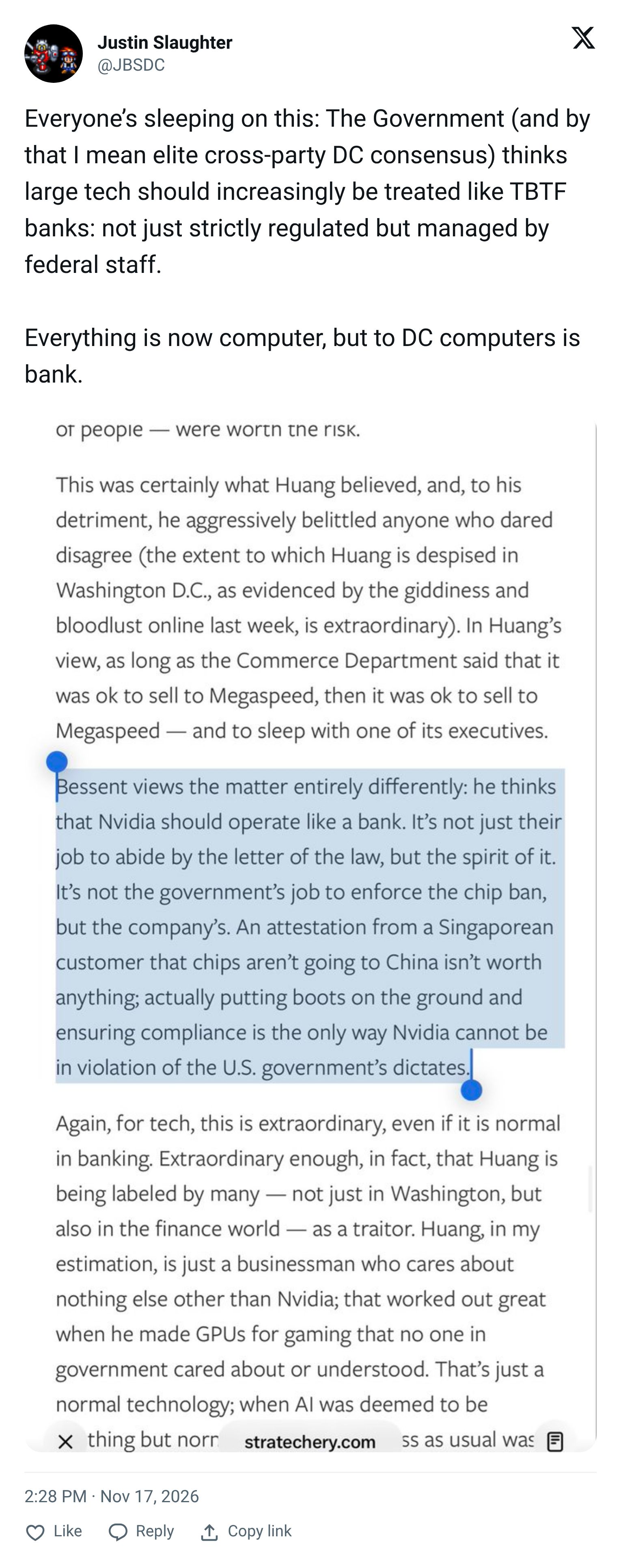
Ben has, as ever, said the thing I was reaching for better than I did. He starts with Jensen Huang’s exit from Nvidia and ends with an obituary for American exceptionalism. The line that stuck with me was Scott Bessent saying that if Nvidia were a bank, the regulators would already be in the building.
🧠 Tech is about to become as politicized as banking. The biggest firms will be treated as too big to fail, and they’ll be expected to enforce government policy through their customers. Today it’s export controls on chips. What comes next looks a lot more like AML and sanctions: know who’s buying, who they’re buying for, and who actually gets to use the compute.
🧠 What’s coming next will make the Biden-era pressure on Big Tech over speech look tiny. China hawks want a say in who gets the chips. AI safety advocates want a say in who gets the models. Almost every political faction has a reason to want control. The internet and tech era we knew in the ’90s and 2000s is ending.
🧠 The willingness to embrace danger at the frontier is what made America special. Don’t get me wrong, I’m not a fan of unfettered capitalism and good government should set the system to ensure the benefits of growth can be widely shared without turning the consumer into a cattle-class victim. Yes, the USA is sometimes ugly, loud, and grotesque. But we already have Europe. We don’t need another one. I couldn’t have built Nerdcon in Europe.
Tweets of the week 🕊
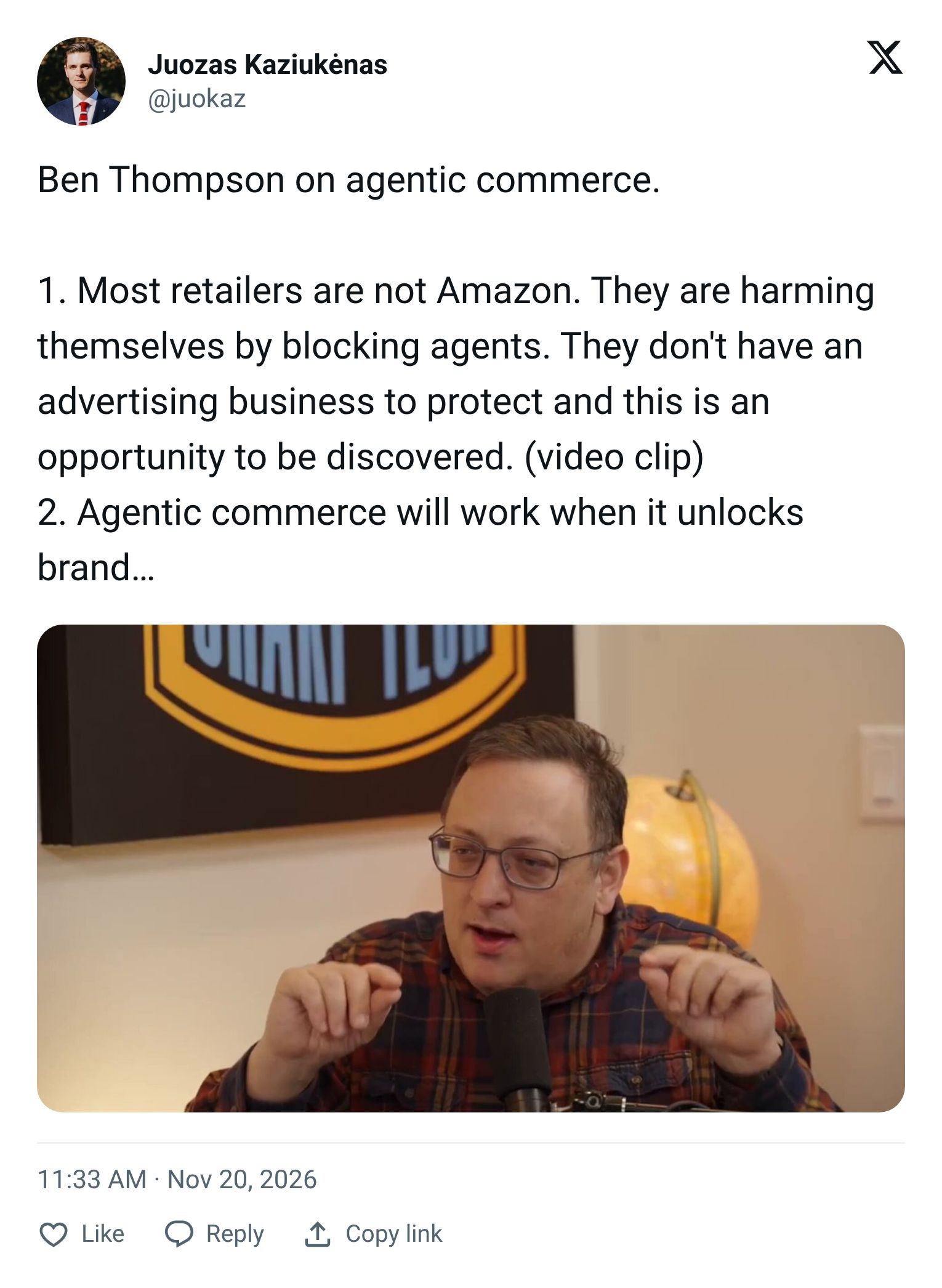
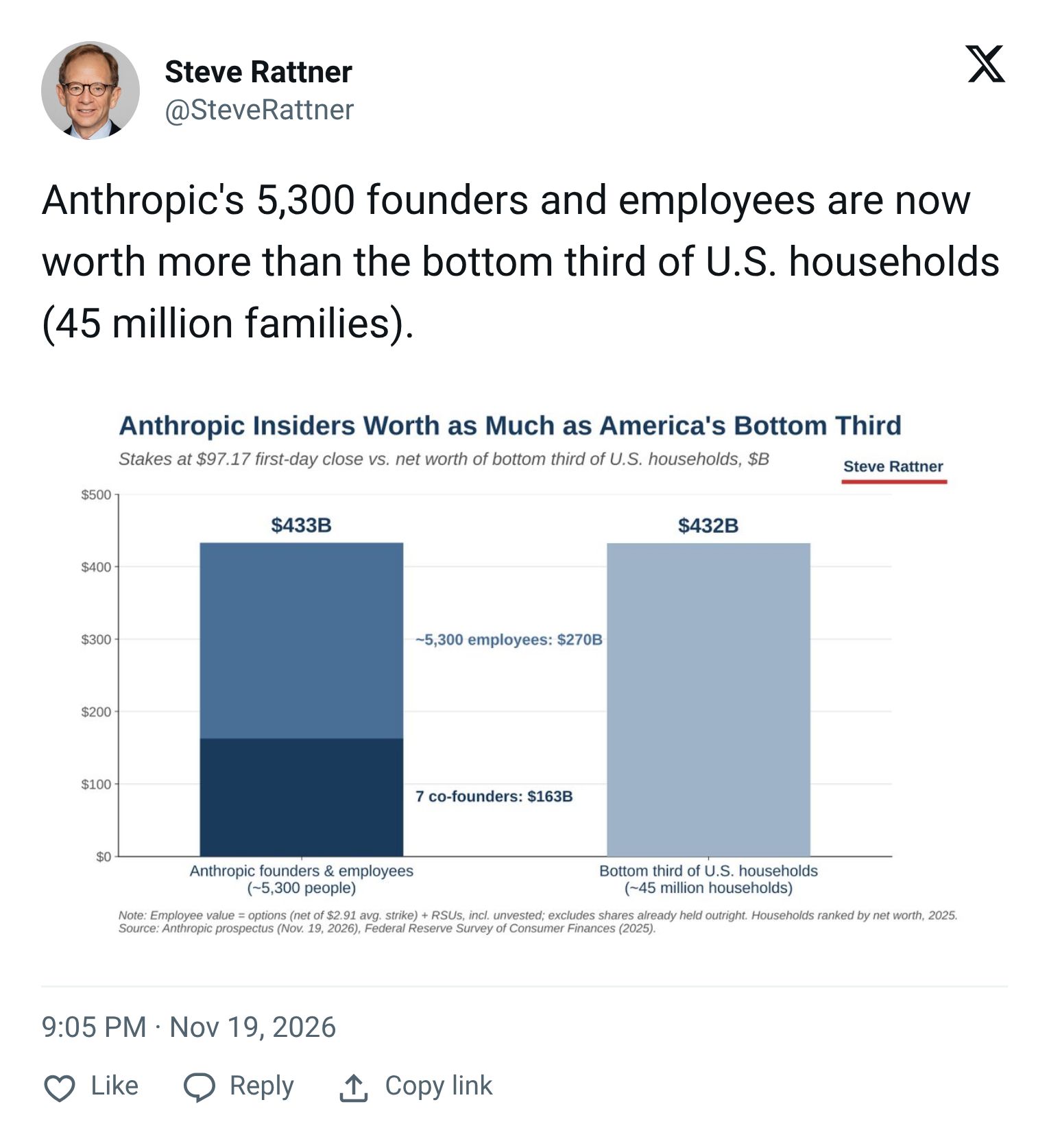
That's all, folks. 👋
Remember, if you're enjoying this content, please do tell all your fintech friends to check it out and hit the subscribe button :)
Want more? I also run the Tokenized podcast and newsletter.
(1) All content and views expressed here are the authors' personal opinions and do not reflect the views of any of their employers or employees.
(2) All companies or assets mentioned by the author in which the author has a personal and/or financial interest are denoted with a *. None of the above constitutes investment advice, and you should seek independent advice before making any investment decisions.
(3) Any companies mentioned are top of mind and used for illustrative purposes only.
(4) A team of researchers has not rigorously fact-checked this. Please don't take it as gospel—strong opinions weakly held
(5) Citations may be missing, and I’ve done my best to cite, but I will always aim to update and correct the live version where possible. If I cited you and got the referencing wrong, please reach out
