
In 2006, the hottest product in American finance was the 2/28 mortgage. Borrowers got two years at a cheap teaser rate, then 28 years at a rate they had no realistic chance of paying.
Which sounds legitimately insane, until you realize nobody planned on year three. The plan was to remortgage before the reset, against a house that was worth more than when you bought it, then do it again. The loan was never designed to be repaid. It was designed to be replaced.
House prices didn't need to rise forever. They needed to keep rising fast. When the 2008 crisis came, the first crack wasn't a sudden collapse in house prices. Appreciation slowed from roughly 15% a year to 8%, the remortgage maths died, and borrowers started tripping into year three at rates they couldn't afford. Then came the foreclosures, the forced selling and the footage of bankers carrying boxes out of Lehman Brothers.
Now look at the frontier AI labs. OpenAI loses tens of billions a year and pays its compute bills by raising new capital at a higher valuation, then doing it again. Equity is not a mortgage, obviously, but the dependency rhymes: today's economics work because tomorrow's financing arrives on better terms. Jay Martin's video on this parallel is worth a watch. I've borrowed his framing.
A 2/28, with GPUs.
So my obvious objection is that this is not 2000.
The infrastructure is not sitting empty. AI revenue is exploding, and the GPUs that are plugged in are close to fully utilized. That's true, and it is exactly why 2008 is the more interesting comparison.
The housing crisis didn't happen because houses stopped being useful. It happened because a financial machine had been built around assumptions about what those useful assets would be worth tomorrow.
An asset can be real and its financing can still go insane.
Wall Street is now rebuilding that machine for compute. The public companies at the center of the buildout represent roughly 40% of the S&P 500, the same index sitting inside millions of pensions and 401k plans.
The useful question is not whether AI demand is fake.
It is how much paper has already been written against demand that must keep climbing. And what happens when that demand curve slows down?
So this week:
AI has never looked better
There are no dark GPUs
Two trillion dollars of promises
Wall Street finances the gap
Nvidia took Fannie Mae's old job
Compute is an asset class now
They’re baack 👇. And as I write this, I’m coincidentally having dinner with the team this evening in SF. I want you to know these guys are the masters of moving all of the payment types: checks, ACH, wires, FedNow, RTP, even stablecoins- all of them. If you’re building and moving money. Make sure you speak to these folks first.

Build products that move money. moderntreasury.com.
Stablecoins are here. Checks, ACH, and wires aren’t going away. RTP, FedNow, and new payment rails keep coming. The challenge isn’t predicting which one wins. It’s supporting all of them without slowing down.
Build faster. Launch sooner. Scale with confidence. Trusted by Procore, Navan, Morse, and companies of all sizes. Backed by $600B+ in payments.
Start building today: moderntreasury.com
1. AI has never looked better
Q2 earnings season was a beat and raise parade. The companies actually selling AI infrastructure are not showing the usual signs of a demand mirage.
Google Cloud did $24.8bn of revenue, up 82%, with a backlog of $514bn, up more than $50bn in a single quarter.
Azure passed $100bn of annual revenue for the first time, growing 43%.
AWS grew 37% to $42.2bn, its fastest growth in 18 quarters.
Nvidia has around $500bn of Blackwell and Rubin purchase commitments through 2026, and the CFO says the figure keeps growing.
So yes, the revenue is real, the demand is real, and the utilization is real.
The returns so far are excellent.
What makes the market nervous is that the spending required to keep those numbers moving is now enormous.
Alphabet printed a monster cloud quarter, and the stock still fell 5% after capex guidance hit $205bn and free cash flow went negative. Infrastructure businesses can produce wonderful revenue and still drown in the commitments made to produce the next dollar of it.
2. There are no dark GPUs
For the last couple of years, four words have been the bulls’ best argument that AI is not dotcom all over again: “there are no dark GPUs.” It is a much better argument than most of the discourse gives it credit for.
In 2002, after the music stopped, 97% of the fiber America had buried for the coming internet age sat dark and unused. Cisco, the poster child of that boom, lost 90% in the crash and only got back to its March 2000 price this past December.
I started my career at British Telecom in September 2000, and I vividly remember the old heads in the office worrying about the share price and their plans for early retirement.
There is a familiar anxiety in the air now.
And the bulls are right.
If a GPU is plugged in and has power, it is not dark. It is close to fully utilized. But the word “if” is doing a lot of lifting in that sentence. Companies cannot get power, grid connections and planning permission in place fast enough. Satya Nadella has already said the quiet part out loud: “you may actually have a bunch of chips sitting in inventory that I can’t plug in.”
Why can’t we plug them in? Because data centers take time.
The grid is constrained, permitting is slow, and local opposition has become politically potent. Sightline Climate estimates 30 to 50% of the large data centers promised for this year will slip. When Zuckerberg starts writing $50,000 bonus cheques to Louisiana teachers out of data center taxes, you know the polling is real.
So the important distinction is not used versus unused. It is bought versus deployed.
We may not get dark GPUs in the dotcom sense. We may get chips that have already been financed but cannot yet be turned into revenue because the building, power or grid connection is late. That gap between spending the money and earning it back is where the financial story starts.
3. Two trillion dollars of promises
In three years, the US has spent more on data center capacity, in inflation-adjusted dollars, than it did on the entire interstate highway system. The highways took 40 years. Despite that spending, far less compute has gone live than has been bought, so a huge part of the boom now exists as contracts for things that will happen later.
Three bits of market plumbing are worth understanding here.
“Backlog” is the hyperscaler’s signed commitment from a customer to use future compute capacity. Backlog is not revenue.
Much of it is expressed through “take-or-pay” contracts, which mean the customer takes the capacity or pays anyway. The hyperscalers now have about $2.1 trillion of supposedly guaranteed take-or-pay backlog.
The third bit is special purpose vehicles (SPVs). More than $1.09 trillion in future payments sit under leases financed by equity investors or special purpose vehicles.
An SPV is simply a separate company created to own a project and the debt used to build it. That keeps the asset, and often much of the leverage, somewhere other than the customer’s own balance sheet.

None of that makes the contracts fake. It does make the timing matter.
If a data center is late, the hyperscaler cannot recognize the revenue when expected. If the lab at the other end of the contract slows its spending, the lease does not disappear. Somebody, somewhere, is still carrying the debt.
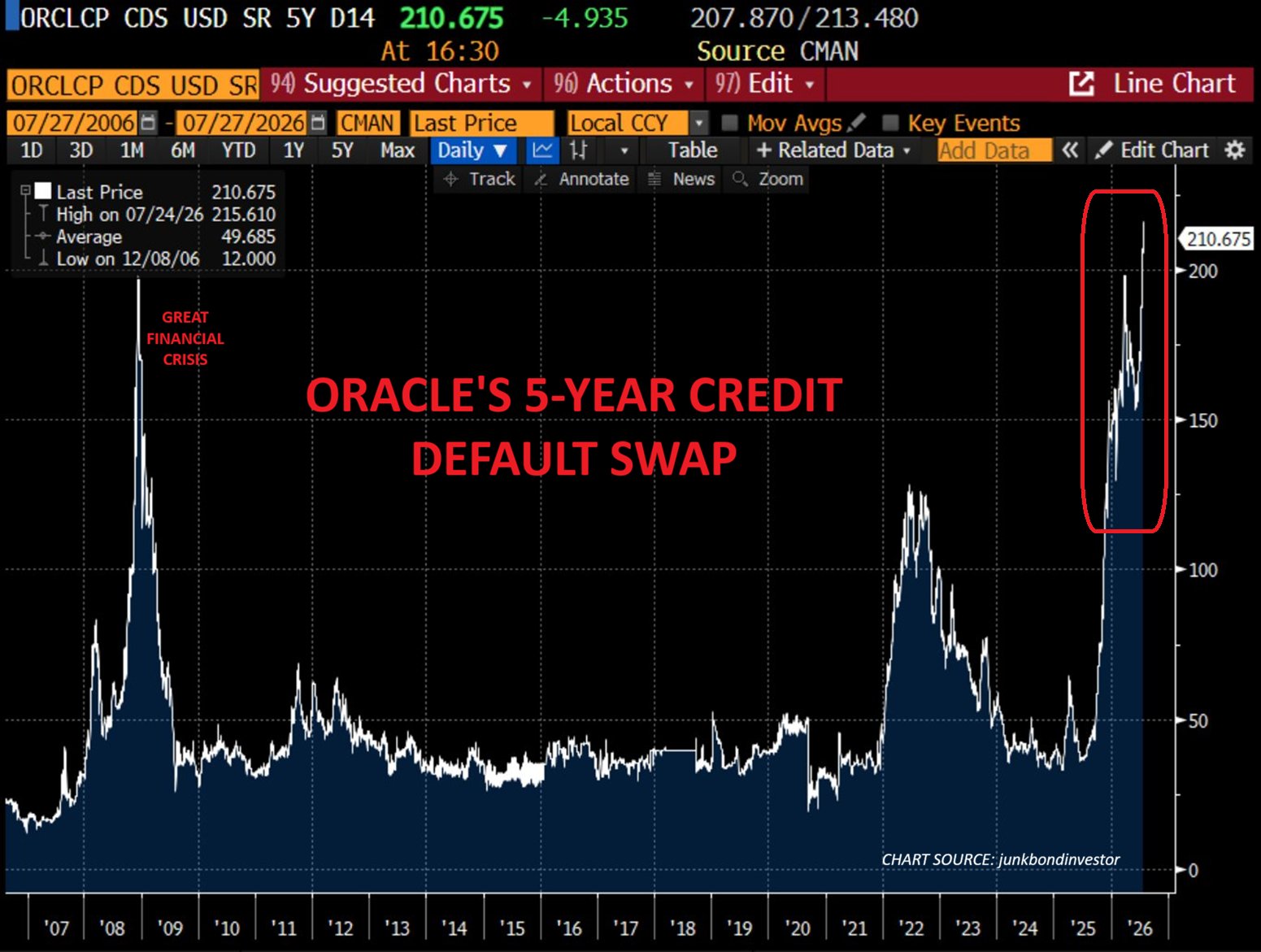
Nobody exemplifies that risk like Oracle. It has bet the company on a $300bn deal with OpenAI and levered up to 4.4x trailing EBITDA to fund it. What happens when investors think a bond is getting riskier? They buy insurance. In debt markets, that insurance is a credit default swap. Read that backwards to understand it. If the credit defaults, the swap pays you cash. You pay a premium for that protection, just like insurance.
The more expensive that insurance gets, the more nervous the bond market is.
Oracle’s insurance is now flashing warning signs. It costs about $215,000 a year to insure $10m of Oracle debt, a record, and Barclays says Oracle CDS has become the market’s favourite hedge on the entire AI trade. When traders want to short the buildout, they do not necessarily short Nvidia.
They buy protection from Larry Ellison YOLO’ing his entire company on compute.
Oh dear.
The honest bull case is that demand is still extraordinary, but it is concentrated. Anthropic went from $9bn of ARR in December to an estimated $74bn by late July, while monthly growth cooled from about 51% in May to about 8%. To be clear, that is not a distressed asset. It may be the fastest private company growth story in history. The warning is simply that a financing machine built for exponential curves does not require failure to get into trouble. It requires the exponent to soften.

House price growth cooling from 15% to 8% was not a crisis either. Right up until the financing built around 15% stopped working.
My question is the same here: how much infrastructure has already been promised against future demand, who financed it, and what happens if the curves stop being exponential?
4. Wall Street finances the gap
The hyperscalers’ free cash flow machines used to pay for all this.
Those companies printed so much cash they could simply build. We are well past that now. Microsoft’s free cash flow is expected to go negative for the first time since at least 2001, while Oracle capex will run at 86% of revenue this year.
When internal cash stops being enough, Wall Street has an answer. It always has an answer.
On August 10th, Jensen Huang sat down on CNBC with the heads of Apollo, BlackRock, Blackstone, Brookfield, Goldman Sachs and KKR to announce platforms aimed at mobilizing $500bn from Wall Street’s deepest pockets so Nvidia’s customers can buy GPUs and build data centers without putting every dollar on their own balance sheets. The basic financial problem is simple: the chips are bought today, the building takes time, and the cash flow arrives later.
Private credit exists to finance the gap.
Blue Owl, one of the largest private credit managers funding the infrastructure boom, is a useful reminder that this money ultimately belongs to investors who sometimes want it back. Over the July 4th weekend, some of its flagship funds gated redemptions, with roughly $14bn trapped inside. Gating is how a fund slows withdrawals so it is not forced to dump illiquid assets into a bad market. It does not mean the fund is insolvent. It does mean liquidity is already part of the story.
This is also where the mortgage rhyme stops being decorative. Ed Zitron calls it the “Subprime Data Center Crisis” because an SPV with active loans but no power is not generating revenue, just as a homeowner whose teaser rate resets still owes the mortgage. The analogy is not exact, but the cash flow problem is recognizable: debt exists before the economics needed to service it do.
Then KKR’s head of digital infrastructure said something that is going to unlock a lot more financing in the future. When you can treat compute as a revenue stream, you can “securitize it, divide the risk, and sell it.”
Securitization is how a pile of individual cash flows becomes standardized paper that institutions can buy.
Once you can do that, compute becomes financial collateral.
5. Nvidia took Fannie Mae's old job
Once compute becomes collateral, lenders need to agree on what counts as bankable compute and what it will be worth later. That is where Nvidia enters the chat.
Marc Rubinstein’s excellent piece explains how Nvidia is becoming the “guarantor of last resort.”
Just as the MBS market required Fannie Mae and Freddie Mac to serve as arbiter, liquidity provider and ultimately guarantor, so Nvidia plays that role in the compute market. As arbiter, its architecture and CUDA ecosystem define what counts as "bankable" compute, the way conforming loan standards defined which mortgages a lender would touch. As liquidity provider, its residual-value guarantees make Nvidia the buyer of last resort if the secondary market falters. And as guarantor, that same backstop is what lets private credit funds underwrite GPU-backed debt as investment grade, much as the GSEs' implicit government support let mortgage debt trade close to risk-free.
And Nvidia has a point.
Famed investor Michael Burry (the guy in The Big Short who predicted the 2008 financial crisis) said that depreciating chips over 6 years was too long. Nvidia released the A100 chips in 2020, and CoreWeave has contracted demand for those chips through 2029. (I’ll let you do the math there).
This is Nvidia’s argument that compute, specifically Nvidia compute, is infrastructure. It is the chips, the CUDA software around them and the long-term demand that makes the asset look more like a toll road or a power station than disposable hardware.
And, oddly enough, the regulator seems to agree with Nvidia’s infrastructure argument.
The same day the CEOs took to CNBC, news broke that the SEC had decided a big chunk of data center bonds aren’t asset-backed securities at all. That sounds like a blessing. It is also a warning, because post-2008 rules such as risk retention, which makes issuers keep some of their own risk, do not apply.
And there isn't enough capex inside the hyperscalers to fund the buildout either. This is the size of the hole:
Between 2028 and 2030, hyperscalers are expected to need another $1.3 trillion in financing. The entire Bloomberg USD investment-grade corporate index is only $8 trillion
Nvidia's version offers residual value support of up to 25% per deal, meaning Nvidia is promising to stand behind some of what a used GPU should still be worth later.
Today this looks like a great bet for Nvidia, because chip hourly prices are increasing.
Silicon Data has H100 rental prices at $2.71 an hour, up from $1.96 in November. Gavin Baker observes that nobody, bull or bear, expected old GPU prices to go vertical. Collateral appreciation is both good news and a warning. House prices were appreciating in 2005 too.
There is one major difference here. Fannie didn't build houses.
Nvidia makes the chips, sets the standard, provides the guarantee, and controls the release cadence that decides when today's collateral becomes yesterday's.
6. Compute is an asset class now
Wall Street will lend against almost anything, but to do so at scale, it needs a standard it can recognize, cash flows it can predict, a way to value collateral, and a market that can transfer risk between buyers and sellers.
Compute now has all of those ingredients.
Nvidia’s CUDA software and hardware provide the standard; take-or-pay contracts supply the cash flows, GPU rental markets provide the price signal, and securitization turns the whole thing into paper that can travel.
And Nvidia is the backstop. By standing behind up to 25% of the residual value in each deal, it gives private credit a cushion if the chips are worth less than expected.
Demand is real, but it is narrow and unusually interconnected.
The labs, hyperscalers, chip companies and capital providers are increasingly each other’s customers, investors and guarantors.
That does not mean AI is about to blow up.
In fact, the bull case is the reason this machine can become so large. The GPUs are full, AI revenue is accelerating, and even older chips are retaining value. A useful asset with rising cash flows is precisely the kind of thing finance loves to standardize, lever and distribute.
The danger is not that the technology turns out to be fake. It is that the financial structure eventually needs more growth than the technology can deliver on schedule. And what happens if demand stops rising as it has?
Which brings us back to your 401k.
The public companies funding this buildout already make up roughly 40% of the S&P 500.
They are already sitting inside the index.
If compute really is becoming the asset class of the age, finance will keep finding ways to put more of it there.
AI can be real, the GPUs can be full, and the paper can still hurt.
The mortgage machine did not break because Americans stopped needing houses. It broke when the financing needed the curve to keep rising faster than reality allowed.
Compute is an asset class now.
And we all have a piece of it.
ST.
If you enjoy this kind of content, I can guarantee you’ll love being in a room of 1,500 other folks who love to go deeper into where finance meets AI. That’s a huge theme for us at this year’s Nerdcon in San Diego on the 19th and 20th November. I’m bringing my audience, the operators, the people who read this newsletter. And it’s the perfect place to find your next hire, client, or just get inspired. Let’s make events awesome again.

That's all, folks. 👋
Remember, if you're enjoying this content, please do tell all your fintech friends to check it out and hit the subscribe button :)
Want more? I also run the Tokenized podcast and newsletter.
(1) All content and views expressed here are the authors' personal opinions and do not reflect the views of any of their employers or employees.
(2) All companies or assets mentioned by the author in which the author has a personal and/or financial interest are denoted with a *. None of the above constitutes investment advice, and you should seek independent advice before making any investment decisions.
(3) Any companies mentioned are top of mind and used for illustrative purposes only.
(4) A team of researchers has not rigorously fact-checked this. Please don't take it as gospel.
(5) Citations may be missing, and I've done my best to cite, but I will always aim to update and correct the live version where possible. If I cited you and got the referencing wrong, please reach out
